
Last updated September 3, 2026
Air Duct Cleaning Permits, Codes & Inspections in IL: What You Need to Know
Nobody pulls a permit to vacuum your ducts. But here’s where homeowners get blindsided: the cleaning itself is one thing — what the cleaning uncovers is something else entirely. In Chicago and across Illinois, the moment a contractor moves from cleaning ductwork to repairing or modifying it, the legal landscape shifts completely. A disconnected trunk line patched without a permit, a leaking plenum sealed on the spot, a flex duct replaced without documentation — these are all permit-required work in most Illinois jurisdictions. By the end of this guide — or for deeper reading, see The Complete Guide to Air Duct Cleaning in Chicago — you’ll know exactly where that line falls, what your obligations are, and how to protect yourself before anyone touches your ductwork.
Quick Answer
Air duct cleaning itself does not require a permit in Illinois — including Chicago. However, any duct repair, replacement, sealing, or HVAC modification that a cleaning inspection reveals does require a permit under the Illinois Plumbing and HVAC codes and the Chicago Building Code, depending on scope. Homeowners who allow unpermitted duct repair work can face disclosure obligations during a real estate sale and potential liability for code violations they didn’t even know existed.
Table of Contents
- The Legal Line: Cleaning vs. Repair and Modification
- How Chicago Building Code Applies to HVAC Ductwork
- Multi-Unit Buildings vs. Single-Family Homes: Different Rules, Different Risk
- What a Duct Inspection Report Can Trigger in an Illinois Real Estate Transaction
- Why You Need a Written Scope of Work Before Anyone Touches Your Ducts
- Illinois HVAC Licensing and How to Verify a Contractor Through IDFPR
- Common Mistakes to Avoid
- When to Call a Professional
- Frequently Asked Questions
- The Bottom Line
The Legal Line: Cleaning vs. Repair and Modification
The single most important distinction in this entire guide is this: cleaning is maintenance, repair is construction. Illinois building law treats them differently, and so does your homeowner’s insurance.
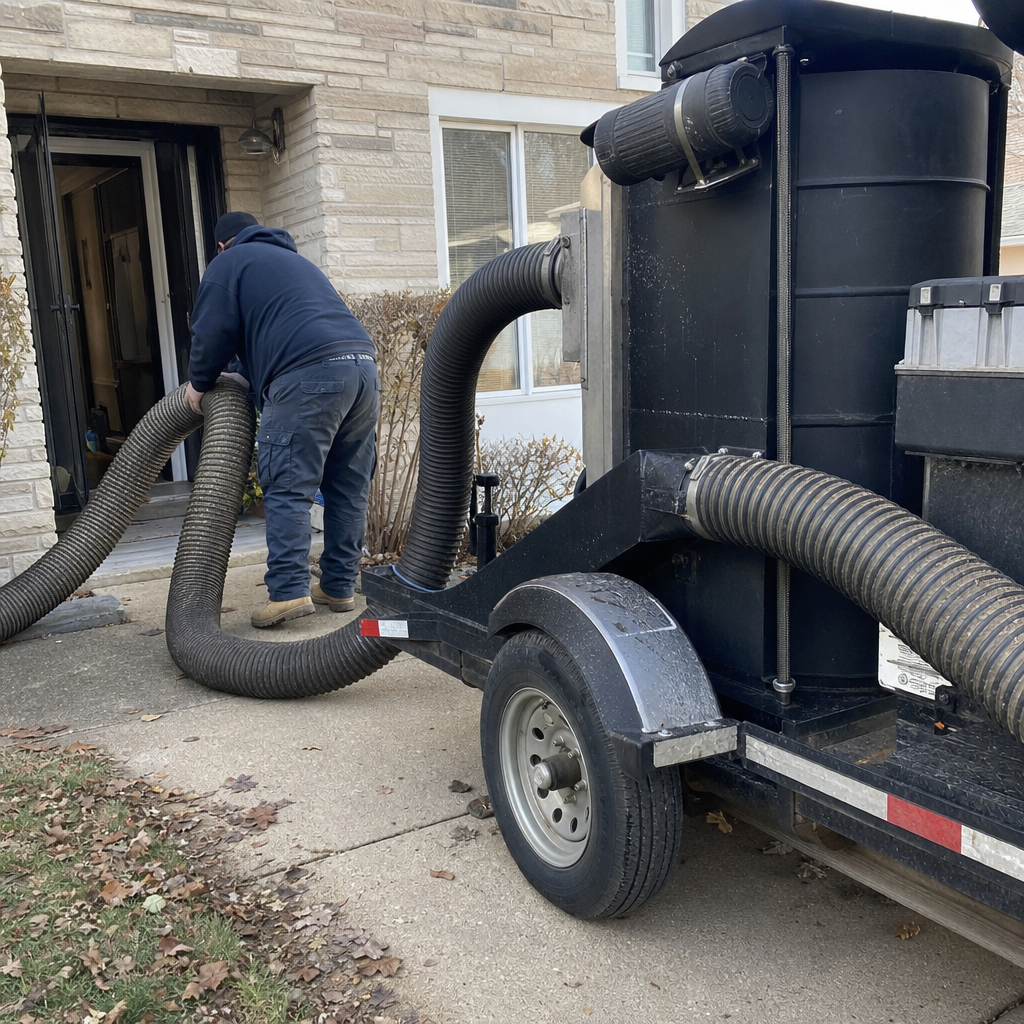
Air duct cleaning — the mechanical agitation and vacuuming of accumulated debris, dust, and microbial contamination from inside your existing ductwork — is classified as routine maintenance. No permit is required anywhere in Illinois to perform it. A contractor using professional-grade Nikro extraction equipment to clean your supply and return lines is doing the same category of work as a plumber snaking a drain: service, not construction.
The line shifts the moment a contractor does any of the following:
- Reconnects a disconnected duct section
- Replaces a damaged flex duct run
- Seals or reseals a plenum, air handler connection, or trunk line with mastic or sheet metal
- Installs a new access panel or register boot
- Modifies duct routing, sizing, or branch configuration
- Adds or relocates a supply or return grille
Every one of those tasks crosses from maintenance into construction or mechanical work — and under Illinois law, mechanical work on HVAC systems requires a permit in virtually every jurisdiction. In Chicago specifically, the Chicago Building Code (CBC) Section 14-M governs mechanical systems, and unpermitted mechanical work creates a code violation that attaches to the property, not just the contractor. That’s a distinction that matters enormously if you ever sell.
How Chicago Building Code Applies to HVAC Ductwork
Chicago adopted its own building code rather than following the Illinois State Building Code wholesale — a fact that catches many suburban contractors off guard when they take on Chicago jobs. The Chicago Building Code, administered by the Chicago Department of Buildings (DOB), incorporates the International Mechanical Code with Chicago-specific amendments.
For ductwork specifically, here’s what Chicago requires:
- Mechanical permits are required for any new ductwork installation, duct alteration, or HVAC equipment replacement.
- Permit applications for mechanical work in Chicago must be submitted through the Chicago DOB’s online permit system, and for larger projects, plans may need to be reviewed by a licensed engineer or registered architect.
- Inspections are required before ductwork is concealed — meaning if a contractor repairs a duct inside a wall cavity and closes it up without a rough-in inspection, the work is automatically non-compliant.
- Licensed contractors only: Chicago requires that mechanical work be performed by or under the supervision of a licensed mechanical contractor. A cleaning company that also “handles repairs on the side” without a mechanical contractor license is operating illegally in Chicago.
For Chicago neighborhoods with older housing stock — think Bridgeport, Pilsen, Avondale, or Irving Park — it’s extremely common for duct cleaning to reveal original mid-century ductwork that has deteriorated. When that happens, the repair conversation needs to happen carefully and on paper, not as a quick add-on during the cleaning appointment.
One practical note: for minor duct sealing using approved mastic compounds — not sheet metal work, not component replacement — Chicago’s interpretation can vary by inspector. The safe move is always to ask your contractor to verify scope with the DOB before proceeding.
Multi-Unit Buildings vs. Single-Family Homes: Different Rules, Different Risk
In Chicago, the building classification matters as much as the work itself. Single-family homes and two-flats operate under different sections of the Chicago Building Code than three-flats, six-flats, and larger residential buildings — and the permit and inspection requirements scale accordingly.
Single-family homes and two-flats (Class A-1 and A-2):
- Routine duct cleaning: no permit required.
- Duct repair or replacement: mechanical permit required; work must be performed by a licensed mechanical contractor.
- HVAC equipment changeout (furnace, air handler): permit required, inspections required.
- Dryer vent repair or rerouting: permit required if it involves modification to the vent path or termination point.
Multi-unit residential buildings (3+ units):
- Any HVAC or duct work — including on shared systems — requires a permit and may require engineering review.
- Shared duct systems serving multiple units are considered building systems; unauthorized modification creates liability not just for the owner but potentially for tenants.
- Chicago’s Multi-Family Housing Ordinance may require additional documentation for HVAC work affecting habitable space.
- In buildings with commercial ground-floor units, ductwork in mixed-use spaces is subject to both residential and commercial mechanical code sections.
Property managers handling buildings in Wicker Park, Logan Square, or Hyde Park — where three-flats and six-flats are common — should treat any ductwork finding from a cleaning inspection as a formal maintenance record requiring follow-up with licensed, permitted contractors. Our Air Duct Cleaning services have covered enough of these buildings over 11 years to know that deferred duct repairs in multi-unit settings create compounding problems: reduced airflow across all units, elevated moisture risk, and, eventually, a code enforcement issue that’s far more expensive than the original repair would have been.
What a Duct Inspection Report Can Trigger in an Illinois Real Estate Transaction
This is the section most homeowners wish they’d read before listing their house.
Illinois has one of the more demanding real estate disclosure frameworks in the country. The Illinois Residential Real Property Disclosure Act (765 ILCS 77) requires sellers to disclose known material defects — and a written duct inspection report that identifies disconnected ducts, deteriorated ductwork, or improper repairs creates documented knowledge of a defect.
Here’s how the sequence typically plays out:
- Homeowner hires a duct cleaning company. Technician notes (verbally or in a report) that there’s a disconnected section in the crawl space or attic.
- Contractor patches the disconnection on the spot as part of the service — no permit pulled, no licensed mechanical contractor involved.
- Homeowner sells the house. Buyer’s inspector finds the repair or the original defect in photos from the duct cleaning report.
- Buyer’s attorney asks: “Was this permitted? Was it disclosed?” If the answer to either is no, the seller is now in a difficult position.
The disclosure obligation doesn’t disappear just because you fixed the problem. If you had documented knowledge of a defect and the repair was unpermitted, Illinois courts have held that the seller knew — or should have known — about the underlying condition.
The practical takeaway: ask your duct cleaning contractor to separate findings from repairs in any written report. Findings go on your maintenance record. Repairs get their own scope-of-work document, a licensed contractor, and a permit.
If you’re preparing for a sale and want a thorough, documented cleaning and inspection — the kind that holds up in a real estate transaction — Air Duct Cleaning in Chicago Lawn is one example of the thorough, documented approach we bring to every residential job.
Why You Need a Written Scope of Work Before Anyone Touches Your Ducts
The single most protective document a homeowner can have before any duct-related work begins is a written, itemized scope of work. This isn’t bureaucracy — it’s protection.
Here’s what to look for in that document:
- Clear separation of cleaning from repair. A scope of work should list cleaning tasks (duct interiors, registers, grilles, air handler components) separately from any repair or modification tasks. If they’re bundled together without distinction, push back.
- Explicit permit statement. If any repair work is included, the scope should state: “This work requires a mechanical permit under [jurisdiction] building code, which [contractor name] will obtain prior to commencing repair work.”
- Contractor license number. For any repair or HVAC work, the contractor’s Illinois HVAC license or mechanical contractor license number should appear on the document.
- Material specifications. If duct sealing is included, the scope should specify the product being used — approved mastic, UL-listed foil tape, or aerosol sealant — since material standards are code-specific.
- Access and restoration plan. If ductwork inside walls or ceilings needs to be accessed, the scope should describe how access is created and how finishes are restored.
- Warranty and documentation commitments. A reputable contractor will commit in writing to providing a copy of the permit, the inspection record, and a completion report — not just a receipt.
A contractor who resists putting any of this in writing is giving you important information about how they operate. Eleven years of duct work in Chicago has shown us that the jobs that go sideways almost always start with a verbal add-on during the cleaning appointment.
Illinois HVAC Licensing and How to Verify a Contractor Through IDFPR
Illinois requires HVAC contractors to hold a state license issued through the Illinois Department of Financial and Professional Regulation (IDFPR). This applies to contractors who install, repair, alter, or replace HVAC systems and ductwork — it does not apply to routine cleaning and maintenance.
That distinction is worth sitting with for a moment. A company like Anchor Air Duct Cleaning is in the business of cleaning, inspecting, and maintaining duct systems — not performing structural HVAC repairs. When our inspections uncover work that crosses into the permit-and-license territory, we say so directly and recommend the homeowner engage a licensed mechanical contractor for that scope; see How to Hire a Air Duct Cleaning Contractor in Chicago: A Step-by-Step Guide for what to look for. That’s not a limitation — it’s integrity.
To verify an HVAC contractor’s license in Illinois:
- Go to the IDFPR License Lookup tool at idfpr.illinois.gov.
- Select “HVAC” as the license type.
- Search by the contractor’s name or business name.
- Confirm the license is active, not expired or suspended.
- Note the license type — an “HVAC Apprentice” license is not sufficient for independent repair work; look for a full HVAC Contractor or Journeyman license.
- Cross-check the license holder’s name against the name on the contract you’ve been given.
In Chicago, the city adds another layer: contractors working on permitted HVAC projects must also hold a City of Chicago contractor’s license, issued through the Department of Business Affairs and Consumer Protection (BACP). A state HVAC license alone isn’t enough for permitted work inside Chicago city limits.
For work involving HVAC system cleaning — as opposed to repair — the relevant credential to look for is NADCA membership (National Air Duct Cleaners Association), which sets industry standards for professional duct cleaning practices. While not a government-issued license, NADCA certification is the professional benchmark for cleaning work specifically. You can also check whether your duct cleaning contractor uses professional-grade extraction systems like Nikro or Rotobrush equipment, which are the standard for thorough, verifiable cleaning — not consumer-grade vacuums.
When we work on HVAC system cleaning and inspection, the Honeywell and Aprilaire components we encounter get documented clearly — so if a licensed HVAC contractor needs to pick up where our scope ends, they have a complete picture of the system.
Common Mistakes to Avoid
- Letting a duct cleaner perform repairs on the spot without a permit. It feels convenient in the moment, but unpermitted repair work attaches to your property and can complicate or derail a future sale. Always get the permit first — even if it adds a few days to the timeline.
- Assuming a cleaning report creates no disclosure obligation. In Illinois, written documentation of a defect — even if subsequently repaired — creates a record that may need to be disclosed. Review any written inspection report carefully before signing off, and consult a real estate attorney if you’re within 24 months of a potential sale.
- Hiring a single contractor to both diagnose and repair without independent verification. A contractor who finds problems and immediately offers to fix them has a financial interest in the findings. In Evanston, Oak Park, and Chicago’s North Shore communities, we regularly hear from homeowners who paid for extensive “repairs” with no permit and no licensed mechanical contractor in sight.
- Treating dryer vent cleaning and duct cleaning as the same regulatory category. They’re not. Dryer vent rerouting or duct replacement is a permit-required modification in most Illinois jurisdictions. If your cleaner says they’re “just cleaning” but relocates your exterior dryer vent termination, ask for the permit. For an honest look at what professional dryer vent service actually involves, see our page on Dryer Vent Cleaning in Chicago Lawn.
- Skipping IDFPR verification for HVAC contractors. A business card and a website are not credentials. A 30-second search on the IDFPR site is. License suspensions and disciplinary actions are public record — take the time to check.
- Confusing multi-unit building rules with single-family rules. Chicago property managers who apply residential single-family code logic to their three-flats or six-flats are operating on incorrect assumptions. The code requirements for shared systems in multi-unit buildings are more demanding, not less.
- Failing to get a copy of the permit and final inspection record. A permit that’s pulled but never finaled is almost as problematic as no permit at all. Require the contractor to provide a copy of the final inspection sign-off — that’s the document that actually closes the loop from a code compliance standpoint.
When to Call a Professional
Call a professional duct cleaning company — as opposed to attempting any form of duct maintenance yourself — any time you suspect active contamination (visible mold, rodent evidence, or persistent odors), when airflow to certain rooms has noticeably declined, or when you’re preparing a property for sale and want documented, defensible proof of duct condition. In Chicago’s climate, where summer humidity and winter heating cycles create real conditions for moisture accumulation inside duct systems, professional inspection every three to five years is reasonable for most homes.
If a cleaning inspection reveals damage — disconnected sections, deteriorated flex duct, collapsed trunk lines — that’s when to pause and bring in a licensed mechanical contractor with a permit in hand before any repair work begins.
Anchor Air Duct Cleaning Service Greater Chicago offers free estimates across Chicago and the surrounding area. Ronald Cooper leads every job personally, and we’re straightforward about what falls within our scope and what requires a permitted mechanical contractor. Call (833) 223-3823 to schedule a no-obligation assessment.
Frequently Asked Questions
No — air duct cleaning does not require a permit anywhere in Illinois. Cleaning is classified as routine maintenance, not construction or mechanical work. Permits are only triggered when ductwork is repaired, replaced, modified, or when HVAC equipment is altered — not for the cleaning of existing, intact systems. If a contractor tells you a permit is required for cleaning, ask them to clarify exactly what work they’re proposing that makes the permit necessary.
Unpermitted mechanical work in Chicago creates a code violation that attaches to the property. When the property is sold, a title search or home inspection may surface the violation. The seller may be required to retroactively permit and inspect the work — or in some cases, undo and redo it — before the sale can close. Chicago’s Department of Buildings can also issue stop-work orders and fines for active unpermitted work. The short answer: the cost of the permit is always less than the cost of the problem it prevents.
Use the IDFPR License Lookup tool at idfpr.illinois.gov, search for the contractor by name under the HVAC license category, and confirm the license is active — not expired, suspended, or lapsed. For work inside Chicago city limits, also verify a City of Chicago contractor’s license through the Department of Business Affairs and Consumer Protection. For duct cleaning specifically (as opposed to repair), NADCA membership is the relevant professional credential. Call (833) 223-3823 if you’d like to discuss what credentials to look for before any work on your system begins.
Yes, it can — and homeowners frequently don’t realize this. Illinois’s Residential Real Property Disclosure Act requires sellers to disclose known material defects. A written inspection report that documents defects like disconnected ducts or deteriorated ductwork creates documented knowledge. If those defects were subsequently repaired without a permit, the unpermitted work itself becomes a disclosure issue. If you’re within 24 months of a potential sale, review any duct inspection report with your real estate attorney before signing anything.
Yes, significantly. Multi-unit residential buildings in Chicago (generally three or more units) are subject to more rigorous permit and inspection requirements than single-family homes. Shared duct or HVAC systems affecting multiple units require permits for any modification, and larger projects may require engineering review. Property managers in neighborhoods like Logan Square, Pilsen, or Bronzeville who own three-flats or six-flats should treat any ductwork finding as a formal maintenance record and engage licensed mechanical contractors — not cleaning-only companies — for any repair scope. Our HVAC Cleaning in Chicago Lawn page gives a clearer picture of what full HVAC system service involves for property owners.
A written scope of work should clearly separate cleaning tasks from repair tasks, include a permit statement for any repair scope, list the contractor’s Illinois HVAC license number, specify materials to be used, describe the access and restoration plan for any enclosed ductwork, and commit to delivering a copy of the permit and final inspection record upon completion. If the document you’re handed doesn’t include these elements for a repair scope, ask for them in writing before any work begins. A contractor who balks at providing a clear scope is telling you something important about how they intend to operate.
The Bottom Line
Air duct cleaning itself is permit-free in Illinois — but the work a cleaning inspection can uncover is not. The line between maintenance and construction is real, it’s legal, and crossing it without the right permits and licensed contractors creates problems that follow the property, not the contractor. In Chicago specifically, the building code adds city-specific requirements on top of state law, and multi-unit buildings carry additional obligations that don’t apply to single-family homes. Know the difference, demand a written scope of work, verify contractor credentials through IDFPR, and treat any repair finding as a separate, documented process. For more guides & resources, explore our blog. That’s how you protect yourself — before, during, and after the job.
Written by Ronald Cooper, Owner & Lead Technician at Anchor Air Duct Cleaning Service Greater Chicago, serving Chicago since 2015.