
Air Duct Sanitizing Service in Chicago, IL — What’s Actually Inside Those Old Ducts, and When Cleaning Alone Isn’t Enough
Air duct sanitizing service in Chicago means mechanically removing debris first with professional-grade equipment, then applying an EPA-registered antimicrobial treatment to the duct surfaces — a two-step process that addresses both particulate buildup and microbial colonization. If you’re in a below-grade or garden-level unit in a lakefront greystone, or any Chicago home with a history of moisture intrusion, sanitizing isn’t optional — it’s the medically appropriate step after cleaning. Call (833) 223-3823 for a free estimate from Ronald Cooper, Owner & Lead Technician at Anchor Air Duct Cleaning Service Greater Chicago. We’re state-licensed, insured & bonded, and Ronald personally runs the equipment on every job.
What Ronald Finds When He Opens a Lakefront Greystone’s Ducts
Here’s the scenario we see regularly, and it’s specific enough to be worth walking through before we get into services or pricing.
A garden-level unit in Edgewater or Rogers Park — the kind in a pre-war greystone building where the unit sits partially below grade — runs its forced-air system through ductwork that was retrofitted into a building never designed for it. The original structure relied on steam radiators. Sometime in the 1960s or early 70s, a contractor carved duct runs through tight cavities, utility closets, and low basement ceilings to bring the building into the forced-air era. That ductwork has been there ever since.
Lake Michigan’s shoreline effect is a real and measurable condition. Lakefront Chicago neighborhoods like Edgewater, Rogers Park, and South Shore experience persistently elevated relative humidity compared to inland neighborhoods — driven by the thermal mass of the lake moderating temperatures and keeping moisture levels high, particularly in late spring and early fall when temperature swings are sharpest. Inside a below-grade unit, that humidity finds its way into ductwork through gaps, poorly sealed joints, and flex-duct connections that have degraded over decades. The duct interior sits at the intersection of darkness, organic debris (dust, dander, insulation particles), and moisture. That’s not a complicated recipe.
What Ronald typically finds in these systems isn’t just dust. It’s a surface layer of debris that, in the right conditions, has become a growth substrate. Running a high-powered vacuum through those ducts without treating the surfaces first doesn’t solve the microbial problem — it just redistributes it. And running the system all Chicago summer without doing either makes both problems measurably worse, because every cooling cycle draws humid air across already-colonized surfaces and circulates the result through every room in the unit.
“Clean ducts aren’t glamorous — but neither is replacing a blower motor because nobody checked what was clogging the airflow for a decade.”
Cleaning vs. Sanitizing — Why the Distinction Matters for Chicago Homes
These two services are not interchangeable, and conflating them is one of the most common sources of confusion we hear from customers who’ve had work done elsewhere and weren’t sure what they actually got.
Cleaning is mechanical. Our Nikro extraction systems use negative air pressure and agitation tools to dislodge and capture the accumulated debris inside your duct runs — dust, debris, insulation fragments, pet dander, and whatever else has settled over years of use. For a Chicago bungalow in Portage Park or Bridgeport with 1960s-era sheet-metal ductwork that’s never been serviced, cleaning alone can be a dramatic improvement. The Nikro equipment we operate is industrial-grade, not the consumer-style shop vac setup that low-bid operators sometimes show up with.
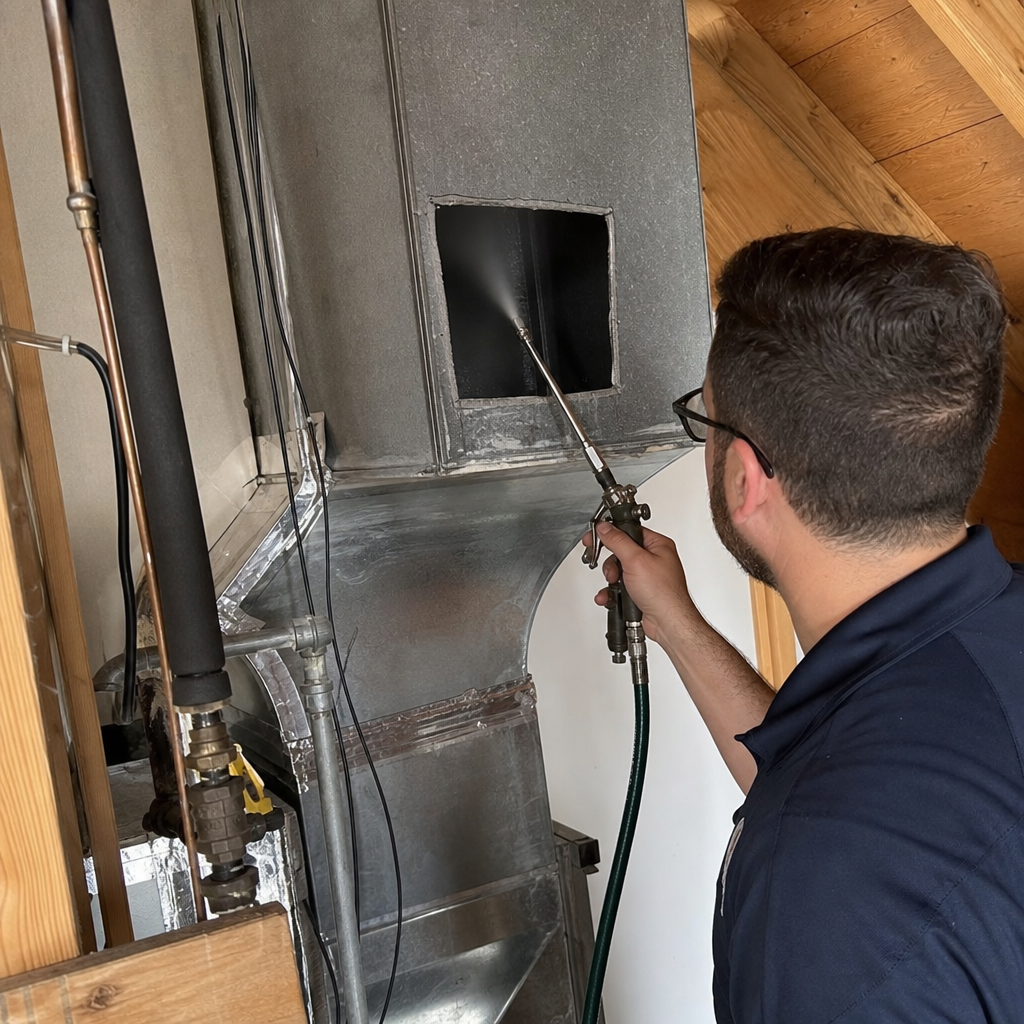
Sanitizing is chemical and biological. After mechanical cleaning, we apply professional-grade antimicrobial treatments — including products from Abatement Technologies and Guardsman — directly to the interior duct surfaces. These are EPA-registered agents formulated specifically for HVAC duct environments, not consumer foggers sprayed into a return vent without prior debris removal. That distinction matters because fogging over an uncleaned duct surface doesn’t treat the problem — it seals contaminants under a treated layer, which is worse than doing nothing.
The sequencing is non-negotiable: mechanical cleaning first, sanitizing treatment second. Any operator who reverses that or skips the mechanical step is not providing sanitizing service — they’re providing the appearance of it.
Our full Air Quality & Sanitizing service follows this exact protocol, and it’s the same process whether we’re treating a single-family bungalow in Beverly or a garden-level two-flat unit off Clark Street in Rogers Park.
The Multi-Unit Building Problem Nobody Talks About
This is the detail that almost no generic sanitizing page covers, and it’s directly relevant to a large share of Chicago’s housing stock.
Chicago’s two-flats and three-flats — particularly on the North and Northwest sides — frequently have duct systems that were installed unit-by-unit during forced-air retrofits, but they run through shared wall cavities, floor-ceiling assemblies, and utility chases that connect the building’s units in ways that weren’t fully sealed. If the first-floor unit has mold-colonized ductwork, the spores don’t stay politely within that unit’s airspace. They migrate through building cavities, penetrations around pipes, and gaps in the floor assembly — and they affect air quality in adjacent units whether those units have been cleaned or not.
This is a cross-unit exposure risk that matters especially in the context of the Air Quality & Sanitizing in Chicago work we do in multi-family buildings. When a property manager calls us for one unit and we find colonized ductwork, we’ll say directly: the adjacent units are worth evaluating before the problem migrates further. That’s not an upsell — it’s the honest assessment of what shared building cavities mean for airborne contaminants in pre-war Chicago construction.
For landlords managing two-flats and three-flats in Edgewater, Rogers Park, or Lincoln Square, addressing sanitizing building-wide rather than unit-by-unit is almost always the more cost-effective and effective approach. We can assess each unit’s system and give you a building-level picture before any work starts.
When Sanitizing Is NOT What Your System Needs
We’d rather tell you this upfront than have you pay for something you don’t need.
If your home is in an inland Chicago neighborhood — think Norwood Park, Jefferson Park, or Edison Park on the Northwest Side — with a duct system installed in the last 15 to 20 years, no history of water intrusion or flooding, and no basement moisture issues, mechanical cleaning is likely all your system needs. The microbial risk is meaningfully lower when relative humidity is controlled, the ductwork is reasonably airtight, and the system hasn’t been exposed to standing water.
Similarly, if you’re in one of Chicago’s roughly 80,000 brick bungalows — built between 1910 and 1940 and retrofitted with forced-air in the postwar decades — and the duct system is in good structural condition with no signs of moisture damage, the most impactful step is usually thorough mechanical cleaning. In many bungalow-belt neighborhoods, that retrofit ductwork has simply never been cleaned since it was installed, and removing 50-plus years of accumulated debris makes an immediate, measurable difference in airflow and air quality without sanitizing ever entering the conversation.
When Ronald assesses your system before starting work, he’ll tell you honestly which step applies. That’s the value of having the owner on the job — there’s no disconnect between the person doing the assessment and the person doing the work, and no incentive to recommend a service that isn’t warranted.
What Air Duct Sanitizing Costs in Chicago
Pricing for air duct sanitizing in Chicago depends on the scope of the duct system, whether cleaning is being performed in the same visit (it should be), and the condition of the ductwork. Below are the ranges we see on typical residential jobs in Chicago.
| Service | Typical Range (Chicago) |
|---|---|
| Air duct cleaning only (single-family home) | $299 – $499 |
| Air duct sanitizing treatment (applied after cleaning) | $99 – $199 |
| Cleaning + sanitizing combined (single-family) | $399 – $699 |
| Two-flat or three-flat (per unit, cleaning + sanitizing) | $350 – $599 per unit |
| Below-grade or heavily contaminated systems (additional) | $75 – $150 surcharge |
These are honest market ranges for Chicago — not teaser prices designed to get a foot in the door. A quote from Anchor Air Duct Cleaning is based on the actual system we’re looking at, not a number pulled off a price sheet. Call (833) 223-3823 for a free estimate — we’ll give you a firm number before any work begins.
What the Job Looks Like, Step by Step
- System assessment: Ronald walks the duct system before starting — checking register locations, identifying the supply and return configuration, and looking for signs of moisture damage, debris accumulation, or prior repairs that might affect access.
- Mechanical cleaning with Nikro equipment: Negative air pressure is established at the air handler, and agitation tools work through the supply and return runs to dislodge debris while the Nikro extraction system captures it. Nothing gets redistributed into your living space.
- Surface inspection post-cleaning: After mechanical cleaning, Ronald inspects the accessible duct surfaces. This is the step that determines whether sanitizing is genuinely indicated — or whether cleaning alone was sufficient.
- Antimicrobial treatment application: Where sanitizing is warranted, we apply EPA-registered agents — including Abatement Technologies and Guardsman products — to the interior duct surfaces via direct application, not fogging into a live return. The treatment is allowed to dwell and dry before the system is returned to operation.
- System restoration and documentation: All access points are resealed. Ronald walks you through what was found, what was done, and whether any follow-up — duct sealing, HVAC cleaning, or a follow-up air quality check — is warranted based on what he saw.
That documentation step matters more than it sounds. If you’re a renter or a property manager dealing with an air quality complaint from a tenant, having a written record of what was found and treated is worth keeping. We can provide that on request.
Ronald Cooper studied HVAC systems at Triton College in River Grove, where hands-on coursework in ventilation and air distribution gave him a foundation that informs how he reads a duct system before he ever turns on the equipment. That training, combined with 11 years of working exclusively in air duct and HVAC cleaning across Chicago, is what separates a thorough assessment from a guesswork walkthrough. For a broader overview of everything under our air quality umbrella, the home page covers our full service scope.
Frequently Asked Questions About Air Duct Sanitizing in Chicago
Air duct sanitizing in Chicago typically runs $99–$199 as a standalone treatment applied after cleaning, or $399–$699 when cleaning and sanitizing are performed together on a single-family home. Multi-unit buildings like two-flats and three-flats are usually priced per unit. Heavily contaminated or below-grade systems may carry a surcharge of $75–$150. Call (833) 223-3823 for a free, no-obligation estimate specific to your system.
Sanitizing is genuinely necessary when there’s evidence of microbial colonization on duct surfaces — most common in below-grade units of older greystone buildings in lakefront neighborhoods like Edgewater and Rogers Park, or in any home with a history of water intrusion. For homes with newer ductwork, no moisture history, and no musty odor, thorough mechanical cleaning is often all that’s needed. Ronald will tell you which applies after assessing your system — he won’t recommend sanitizing where cleaning alone is the right call.
A persistent musty smell from vents is one of the clearest indicators that microbial growth on duct surfaces is the issue — and yes, professional cleaning followed by proper sanitizing treatment typically resolves it. Consumer foggers or duct deodorizers applied without prior mechanical cleaning mask the odor temporarily but don’t eliminate the source. If the smell returns after a prior “cleaning,” the mechanical debris removal step was likely skipped or insufficient.
Most Chicago homes don’t need sanitizing on a recurring schedule — it’s a remedial step, not routine maintenance. Mechanical duct cleaning every 5–7 years is a reasonable baseline for a typical Chicago single-family home. Sanitizing becomes relevant again if there’s a new moisture event, visible mold evidence, or a tenant or family member with unexplained respiratory symptoms that improve when they’re out of the building. Below-grade lakefront units warrant more frequent assessment given the persistent humidity conditions.
Schedule Your Free Estimate
If you’re in a lakefront Chicago neighborhood and wondering what’s actually living inside your ductwork, or if you’re a property manager dealing with a tenant air quality complaint in a greystone two-flat, the honest first step is finding air quality and sanitizing near you in Chicago, IL with someone who’ll tell you what they actually find. Ronald Cooper leads every job personally — from the initial walkthrough to the final system restoration. Call (833) 223-3823 to schedule a free estimate. No pressure, no guesswork — just a straight answer about what your system needs and what it’ll cost.
Written by Ronald Cooper, Owner & Lead Technician at Anchor Air Duct Cleaning Service Greater Chicago, serving Chicago, IL.
What Our Customers Say
"Two guys, about three hours, plastic down at every register, and they wiped the vent covers before putting them back."
— Jasmine Robinson"Told me straight that our ducts were in decent shape and didn't need doing every year like the mailer companies claim."
— Gabriela Reyes"My wife's allergies had been bad in this house since we moved in. It's been two months since they did the ducts and it's noticeably better. Not a miracle, but real."
— Brian Barrett