
Signs You Need Dryer Vent Cleaning in Chicago — and Why Chicago Homes Make Them Harder to Spot
The clearest signs you need dryer vent cleaning are clothes that take two cycles to dry, a dryer that’s hot to the touch on the outside, and a laundry room that smells like something’s burning. Those are real indicators — but in Chicago’s converted greystones, two-flats, and bungalows, where dryer vents often run 18 to 25 feet through interior walls and repurposed closet space before they reach the outside, dangerous lint accumulation can build for months before those symptoms ever appear. If you’re in Chicago and something feels off with your dryer, call (833) 223-3823 — Anchor Air Duct Cleaning offers Affordable Dryer Vent Cleaning in Chicago, IL with free estimates, and we’ll tell you honestly what we find.
Why Chicago’s Housing Stock Changes Everything About Dryer Vent Warning Signs
Most dryer vent guides are written with a standard setup in mind: a short, mostly straight run from the back of the dryer through an exterior wall, maybe 5 to 8 feet total. That setup gives you fast, obvious feedback. When lint starts blocking a short vent, drying times spike quickly and the problem is hard to ignore.
In a converted greystone unit in Wicker Park or Logan Square, that math doesn’t hold. The vent might run 20 feet or more through a closet, turn two or three elbows around a support wall, pass through a floor cavity, and eventually exit through a shared building chase. You’ll never see that route. Most of our customers haven’t thought about it since the day they moved in.
Here’s what that geometry does to the warning signs: each elbow in a long interior run is a lint trap. Lint is turbulent air’s passenger — it follows the exhaust stream until it slows down, and it slows down at every bend. A vent with four elbows can hit meaningful accumulation levels in less than half the time a straight exterior run would, regardless of how new your dryer is or how often you clean the lint screen. The screen catches fiber. It does nothing for the grease-bonded, moisture-compressed lint that coats the inside wall of a 90-degree elbow two floors above your laundry closet.
So when we talk about signs you need Best Dryer Vent Cleaning in Chicago, IL, we’re really talking about two categories: the standard symptoms you’d read about anywhere, and the subtler Chicago-specific signals that show up earlier in the timeline — if you know what to look for.
The Warning Signs: Standard and Chicago-Specific, Side by Side
Below is how the common warning signs actually present in Chicago’s older housing stock versus how the same symptom shows up in a straightforward modern setup. The differences matter because they explain why so many Chicago homeowners dismiss early signs as normal dryer wear rather than a vent problem that needs attention.
| Warning Sign | How It Looks in a Standard Short Vent Run | How It Looks in a Chicago Long Interior Run |
|---|---|---|
| Extended drying time | Sudden jump — one cycle becomes two, fast | Gradual creep over weeks — you just start running the dryer a second time without thinking about why |
| Dryer overheating | Dryer is hot to the touch; clothes come out scorching | Dryer runs warmer than usual but not dramatically — the long vent dissipates heat before it registers as extreme |
| Burning smell | Sharp, immediate, hard to ignore | Faint, intermittent — easy to write off as “dust burning off” in winter when the furnace kicks on nearby |
| Humidity buildup in the unit | Rarely occurs — exhaust exits cleanly | More common in below-grade or interior Chicago apartments — moisture-laden exhaust pushes back into the living space when the vent is partially blocked |
| Lint around the vent cap | Visible, obvious | The exterior cap may look fine while the obstruction is deep inside the interior run — this is the most dangerous scenario |
That humidity sign deserves its own moment. In below-grade units in older Chicago greystones — the kind that are common on the near Northwest Side — a partially blocked dryer vent stops expelling moisture-laden exhaust cleanly. That exhaust has to go somewhere, and it often seeps back into the utility space or laundry closet. If your laundry area feels damp after a drying cycle, or you’re seeing condensation on nearby walls in winter, the dryer vent deserves a close look before you start chasing a plumbing or waterproofing explanation.
What a Homeowner Can Actually Check — and Where the Limit Is
There’s a version of this conversation that ends with “check your exterior vent cap and call it good.” That’s not useful advice for most Chicago homes, so let’s be specific about what a self-check actually covers.
You can reasonably inspect two things without any tools:
- The exterior vent cap. Go outside, find where your dryer exhausts (usually a louvered or flap-style cap on the building exterior or soffit), and check that the flap opens freely when the dryer is running. A capped or blocked exterior termination is an immediate fire hazard and the easiest thing to catch yourself.
- The first foot of duct behind the dryer. Pull the dryer away from the wall, disconnect the flexible transition duct, and look inside with a flashlight. Heavy lint buildup right at the dryer outlet is a real finding, though it’s rarely where the most dangerous accumulation sits.
That’s the honest scope of a DIY check. The middle section of a long interior run — the part that snakes through your walls or closets — is not accessible without professional equipment. That’s where the compacted, fire-ready lint lives, and it’s the section that no amount of vacuuming from the dryer end or exterior end will fully clear on a long, multi-elbow run.
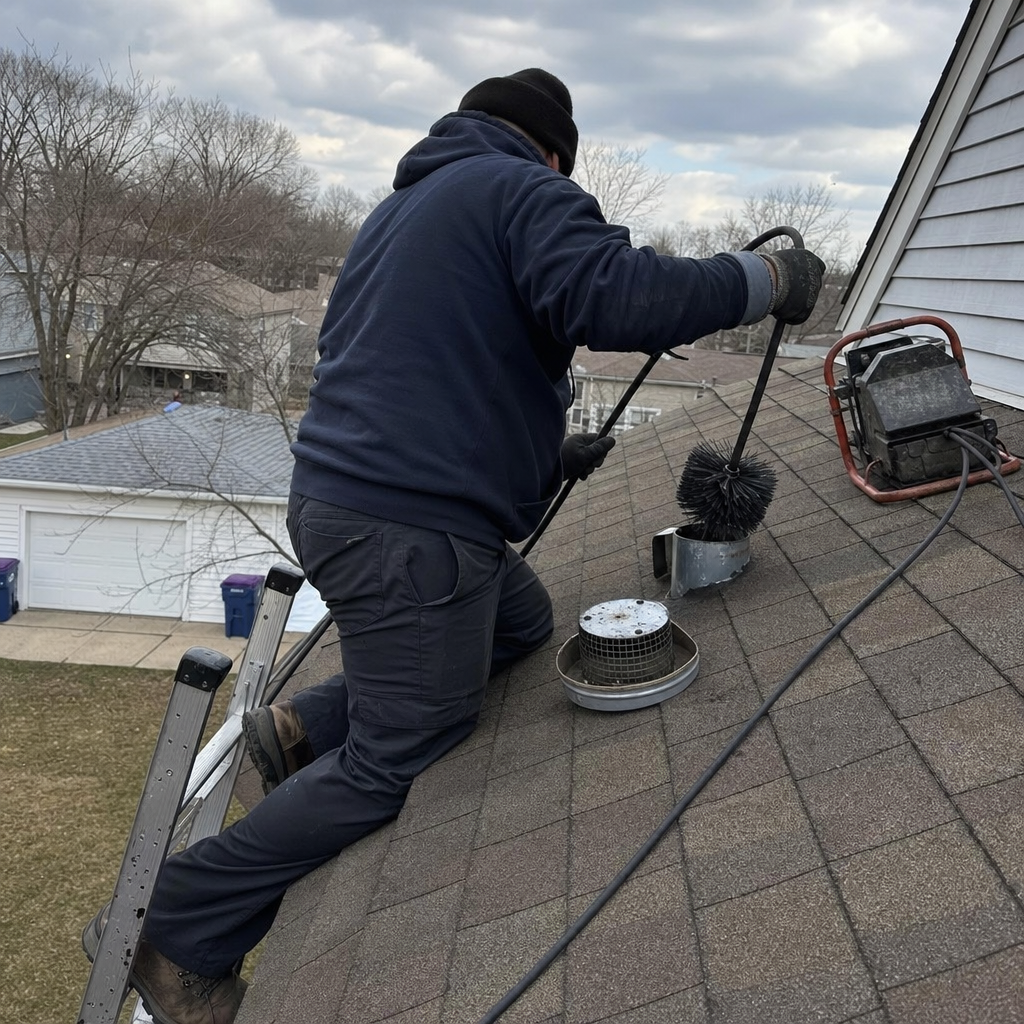
We use flexible rotary brush systems that travel the full length of the vent, combined with high-powered extraction that pulls the dislodged material out rather than pushing it further in. On long Chicago interior runs, that’s not optional — it’s the only way to actually clear the elbows where lint accumulates most heavily. If you want to understand the full scope of what that service involves, our Dryer Vent Cleaning in Chicago page covers it in detail.
The Elbow Problem in Converted Chicago Buildings
Ronald Cooper, our owner and lead technician, grew up in Bridgeport and has been cleaning duct and vent systems in Chicago for 11 years. He’ll tell you that the single most consistent finding in converted Chicago greystone and two-flat buildings isn’t a blocked exterior cap or a crushed flexible duct — it’s a 90-degree elbow somewhere in the middle of an interior run that nobody has thought about since the vent was installed.
In those buildings, dryer vents were often added as an afterthought during renovation, routed around structural obstacles that couldn’t be moved. The result is a vent path with more geometry than function — elbows that exist because the wall said so, not because they’re optimal for airflow. Each of those elbows reduces the effective pull of the exhaust fan, increases lint deposition, and shortens the service interval before cleaning is genuinely necessary.
A vent like that on a standard annual cleaning schedule may actually need attention every 12 to 18 months depending on usage, household size, and the type of laundry being dried — so if you’re wondering How Much Does Dryer Vent Cleaning Cost? (2026 Price Guide) — Chicago, IL, the answer depends on these same factors. Heavy items like comforters, towels, and pet bedding shed significantly more lint than light loads — and a Chicago household running four to five loads a week through a 20-foot vent with four elbows is a different situation entirely from the “clean every two years” guidance that appears in most general dryer maintenance articles.
Clean ducts aren’t glamorous — but neither is replacing a blower motor because nobody checked what was clogging the airflow for a decade. The same logic applies here.
When Dryer Vent Cleaning Connects to the Bigger Air Quality Picture
Chicago has roughly 80,000 bungalows built between 1910 and 1940 — brick homes that ran on steam heat for decades before being retrofitted with forced-air ductwork, often in the 1960s or 70s. In those homes, the dryer vent and the air duct system often share the same neglected maintenance history: neither has been professionally serviced since the retrofit, both run through tight spaces that were never designed for them, and both accumulate debris at a rate that the original builders never anticipated.
When Ronald assesses a dryer vent in one of these homes, he’s frequently looking at an air duct system with the same story. Because Anchor’s services cover dryer vent cleaning alongside full air duct cleaning, HVAC cleaning, duct repair and sealing, and air quality sanitizing, a single visit can address both systems — which matters practically for Chicago homeowners who don’t want to schedule and coordinate multiple specialists for work that’s fundamentally connected.
That’s not an upsell framing. It’s what makes sense when the same 1968 house has a dryer vent that hasn’t been touched and a supply duct system that’s been pushing debris-laden air through the house every winter since the Ford administration. If you’d like to learn more about how we work across these systems, start at our home page for the full picture of what Anchor covers.
Frequently Asked Questions About Dryer Vent Cleaning Signs in Chicago
If clothes are taking longer to dry but the dryer drum is spinning normally and the heating element is working, the vent is almost always the cause — a restricted vent starves the drying cycle of the airflow it needs to exhaust moisture. Test it simply: disconnect the flexible duct at the back of the dryer and run a cycle with the duct open to the room. If drying time improves dramatically, the dryer is fine and the vent is the issue. Keep in mind that running a dryer without its vent exhausting properly introduces heat and lint into your living space, so this is a diagnostic test, not an ongoing workaround — call (833) 223-3823 for an assessment rather than operating it that way long-term.
In Chicago multi-unit buildings with long interior vent runs, annual cleaning is a reasonable baseline — and in heavy-use situations like a household doing five or more loads per week, every 12 months is a hard floor, not a suggestion. Short, straight exterior-wall vents in newer construction can go 18 to 24 months between cleanings, but that interval doesn’t apply to the 20-foot rerouted interior runs common in converted greystones and two-flats. Usage patterns matter significantly: pet owners and households that dry heavy items frequently accumulate lint faster and should err toward the shorter end of any recommended interval.
A blocked dryer vent is a genuine fire hazard — lint is highly flammable, and the combination of heat, oxygen restriction, and compressed dry fiber inside a blocked vent creates conditions that can ignite. The U.S. Fire Administration attributes thousands of residential fires annually to dryer vent issues, with failure to clean the vent cited as a leading factor. In Chicago’s older housing stock, where vent runs are longer and less accessible than in modern construction, the risk is higher because the most dangerous accumulation points are the ones a homeowner can’t see or reach. This is not a scare tactic — it’s the practical reason professional cleaning tools travel the full length of the vent rather than working from the ends.
You can clean the accessible sections — the area right behind the dryer and the exterior termination point — but a long interior run in a converted Chicago building requires professional equipment to clean thoroughly. Consumer dryer vent brush kits are designed for short, straight runs; on a 20-foot run with multiple elbows, they often dislodge lint without extracting it, redistributing the material rather than removing it. For the middle sections of an interior run, a rotary brush system with concurrent extraction — the kind of setup we run on every job — is necessary to actually clear the elbows where compacted lint accumulates. The exterior cap and the first foot behind the dryer are worth checking yourself, but they’re not a substitute for a full professional cleaning on a long-run Chicago vent.
Schedule a Dryer Vent Assessment in Chicago
If any of these signs sound familiar — gradual drying time increases, a laundry area that feels damper than it should, a vent run you’ve never thought about since you moved in — we’re worth a call. Anchor Air Duct Cleaning serves Chicago homeowners from Logan Square to Bridgeport, and every job is led by Ronald Cooper personally. Estimates are free and there’s no pressure. Call (833) 223-3823 and we’ll tell you exactly what we find.
For the full breakdown of what our dryer vent service includes, visit our Dryer Vent Cleaning page.
Written by Ronald Cooper, Owner & Lead Technician at Anchor Air Duct Cleaning Service Greater Chicago, serving Chicago, IL.