
Last updated September 3, 2026
The Complete Guide to Air Duct Cleaning in Chicago
Most air duct cleaning guides are written for a hypothetical house in a hypothetical city. Chicago is neither. With 77 distinct neighborhoods, lake-effect humidity off Lake Michigan, and hundreds of thousands of homes built before 1970, the duct systems running beneath Chicago floors and through Chicago walls have a story that generic national advice never tells. The EPA estimates that Americans spend 90% of their time indoors — and in a Chicago winter, that number is even higher. This guide covers what actually happens inside aging Chicago ductwork, how to tell a legitimate cleaning from a scam, and what questions to ask before you let anyone hook a hose to your system — or read our How to Hire a Air Duct Cleaning Contractor in Chicago: A Step-by-Step Guide for deeper vetting advice.
Quick Answer
Our Air Duct Cleaning services in Chicago typically cost $300–$600 for a standard residential system, take 2–4 hours, and should be performed every 3–5 years — or sooner in older pre-1970 homes with original ductwork. Chicago’s lake-effect humidity and aging housing stock accelerate dust, mold spore, and allergen buildup faster than drier Midwestern cities, making regular cleaning more than routine maintenance.
Table of Contents
- Why Chicago’s Housing Stock Makes Duct Cleaning Different
- How Lake-Effect Humidity Affects Your Ductwork
- Chicago Bungalow Octopus Systems: A Category of Their Own
- How Much Does Air Duct Cleaning Cost in Chicago?
- Legitimate Service vs. the “Blow and Go” Scam
- How to Read a Post-Cleaning Report
- Which Chicago Neighborhoods Have the Oldest Ductwork
- Common Mistakes to Avoid
- When to Call a Professional
- Frequently Asked Questions
- The Bottom Line
Why Chicago’s Housing Stock Makes Duct Cleaning Different
The Chicago metropolitan area contains one of the densest concentrations of pre-1970 residential housing in the entire Midwest. Block after block of Chicago bungalows, two-flats, and postwar ranch homes were built in eras when ductwork design was driven by material cost and construction speed — not airflow efficiency or long-term cleanability. That matters enormously when you’re trying to maintain indoor air quality decades later.
Modern homes are typically built with smooth-walled sheet metal or flexible duct runs that follow relatively direct paths. Older Chicago homes — particularly the iconic brick bungalows that line neighborhoods from Bridgeport to Edison Park — were built with octopus furnace systems and gravity-fed duct configurations that branch, angle, and dead-end in ways that trap debris far more aggressively than anything a national cleaning guide accounts for.
There are also material considerations. Many pre-1980 Chicago homes still have original galvanized steel ducts with interior seams that collect particulate matter, or fiberglass-lined ductwork that can harbor mold colonies once the lining begins to deteriorate. In some cases, older construction used asbestos-containing insulation in or around duct systems — a scenario that requires professional assessment before any cleaning is performed.
The takeaway: if your Chicago home was built before 1975, the national average cleaning cycle of every 3–5 years may not apply. For a full seasonal breakdown, see our Seasonal Air Duct Cleaning Care for Chicago: Year-Round Homeowner’s Guide. In our experience working across Chicago, homes in this age bracket often show significant contamination inside duct runs as early as 2–3 years after a prior cleaning, particularly in basements and first-floor supply runs where humidity and temperature fluctuations are most pronounced.
How Lake-Effect Humidity Affects Your Ductwork
Chicago’s relationship with Lake Michigan is many things — scenic, economically vital, and, for your ductwork, a persistent source of elevated indoor humidity that drier Midwestern cities simply don’t experience at the same scale.
Lake-effect weather patterns push moisture-laden air inland from late spring through early fall. That moisture doesn’t stay outside. It infiltrates older homes through gaps in window frames, foundation cracks, and the kind of building envelope imperfections that are common in Chicago’s century-old housing stock. Once that humid air enters the HVAC system, it creates conditions inside duct runs where dust and biological matter don’t just accumulate — they compact and, in the right temperature window, support mold and dust mite colonies.
Dust mites thrive at relative humidity levels above 50%. During a Chicago summer, indoor humidity in an unconditioned basement regularly exceeds that threshold. Basement duct runs — the starting point for most forced-air systems — become collection chambers for particulate matter that gets distributed to every room each time the system cycles.
Mold spore accumulation in Chicago ductwork is also meaningfully higher than in cities like Indianapolis or Kansas City, where summer humidity is lower and building stock is newer on average. We’ve opened duct panels in Pilsen two-flats and Avondale bungalows and found mold growth that had gone undetected for years because it was buried 15 feet into a return air run — invisible to any inspection that didn’t use a camera.
The practical implication: Chicago homeowners should treat air duct cleaning as a humidity-management strategy, not just a dust-removal task. Pairing a duct cleaning with an Aprilaire whole-home dehumidifier installation or a post-cleaning sanitizing treatment — products like those from Abatement Technologies are specifically formulated for duct interior application — addresses the root cause rather than just the symptom.
Chicago Bungalow Octopus Systems: A Category of Their Own
If you own a Chicago bungalow built between 1910 and 1955, there’s a good chance your home was originally heated by a gravity-fed octopus furnace — a large central unit with multiple large-diameter round ducts radiating outward in all directions like arms. Even if the original furnace has been replaced with a modern forced-air system, many of those original duct runs remain in place, retrofitted into the new layout.
These systems present cleaning challenges that modern HVAC equipment was never designed to handle:
- Large-diameter trunk lines: Original octopus ducts are often 10–16 inches in diameter, which means smaller residential cleaning brushes don’t make contact with the duct walls. You need industrial-grade rotating brush systems — like the Rotobrush units we operate — that are sized for commercial and industrial applications.
- Irregular access points: Modern duct systems have standardized register locations that make access predictable. Octopus systems often require cutting temporary access panels in areas that weren’t designed for service entry.
- Dead-end branches: Many original octopus systems have branch runs that were capped off when the furnace was replaced but never removed. These dead sections collect debris with no airflow to displace it and are frequently missed entirely by contractors using basic vacuum-only approaches.
- Settled debris loads: In a duct system that has been in place for 60–80 years, the bottom of trunk lines can accumulate inches of compacted dust, insulation fragments, and biological material. Dislodging this requires mechanical agitation — not just suction.
When evaluating a contractor for a Chicago bungalow, ask directly whether their equipment is sized for large-diameter trunk ducts and whether they have experience with pre-1960 duct configurations. The answer tells you quickly whether they’ve actually worked in this city’s housing stock or just printed a Chicago zip code on their website.
How Much Does Air Duct Cleaning Cost in Chicago?
Air duct cleaning in Chicago typically runs $300–$600 for a standard single-family home, with pricing influenced by system size, duct age and complexity, and whether additional services like sanitizing or dryer vent cleaning are included. Here’s a realistic breakdown of what you’ll encounter in the Chicago market:
| Service | Typical Chicago Price Range |
|---|---|
| Air duct cleaning (standard 1,200–2,000 sq ft home) | $300 – $450 |
| Air duct cleaning (larger home, 2,000–3,500 sq ft) | $450 – $600 |
| Older bungalow / octopus system (added complexity) | $500 – $750 |
| Duct sanitizing treatment (post-cleaning) | $75 – $150 |
| Dryer vent cleaning (added to same visit) | $89 – $150 |
| HVAC coil and blower cleaning | $150 – $300 |
Be wary of quotes significantly below $150 for a whole-home service. In the Chicago market, that price point is the calling card of the “blow and go” operator — more on that in the next section. A legitimate cleaning at the right price reflects the actual labor, equipment, and time the job requires.
For an exact quote on your specific Chicago home, call (833) 223-3823 — estimates are free and specific to your system, not a one-size-fits-all number.
Legitimate Service vs. the “Blow and Go” Scam
Chicago has been a documented target market for low-bid duct cleaning scams for years. The pattern is predictable: a company advertises whole-home duct cleaning for $49–$99, arrives with a shop-vac-grade portable unit, spends 45 minutes in the house, and leaves with your money. Nothing meaningful was cleaned. Consumer affairs offices across Cook County have received consistent complaints about this model.
Here’s how to tell the difference between a legitimate cleaning and a “blow and go” operation before anyone touches your system:
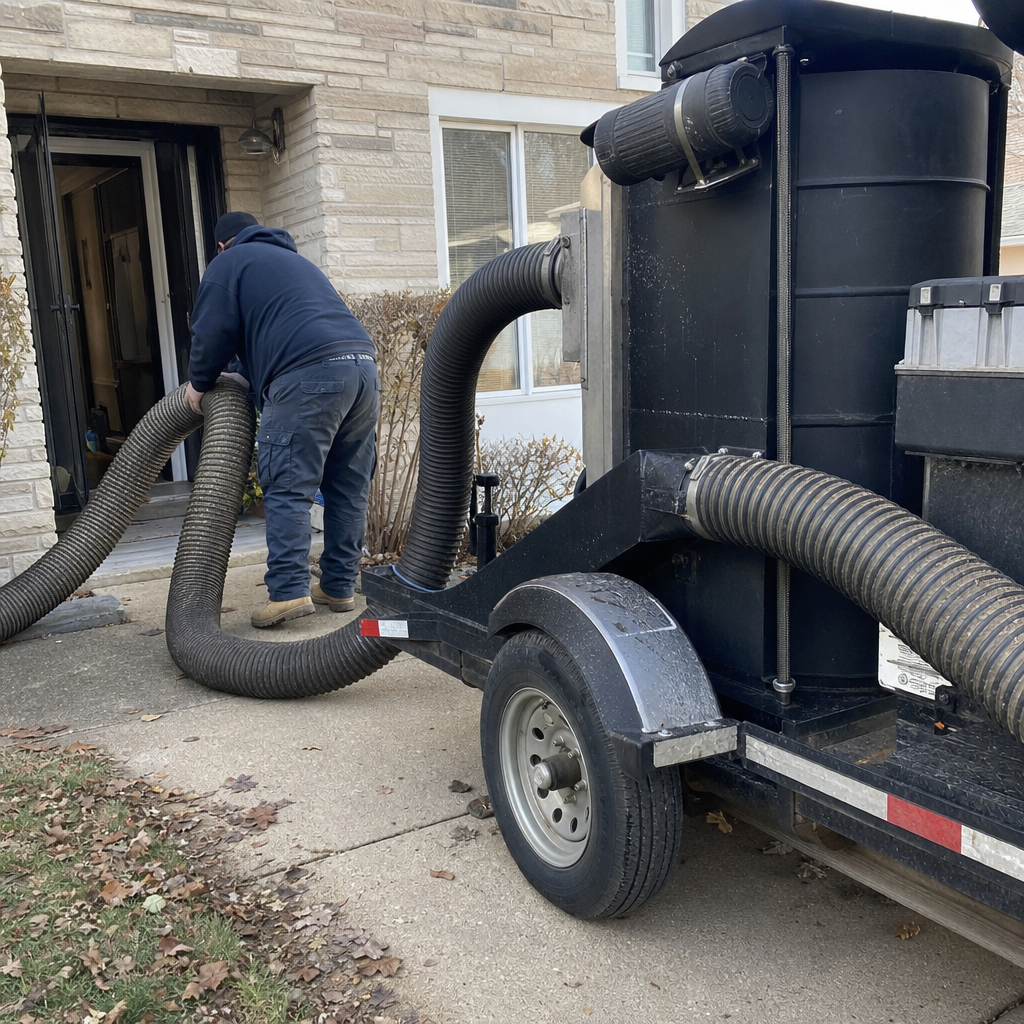
- Ask about the equipment. A legitimate contractor uses truck-mounted or high-powered portable vacuum systems with HEPA filtration that creates negative pressure in the duct system. Professional-grade units like the Nikro systems used by industrial contractors move 16,000+ CFM of air. A shop vac moves roughly 100 CFM. The math is not subtle.
- Ask how access points are created. Proper source removal requires cutting access holes in the ductwork at key locations so the technician can physically insert brushes and nozzles. If a contractor tells you they don’t need to cut any access, they’re not doing source removal — they’re blowing debris around.
- Ask about agitation methods. Suction alone doesn’t dislodge compacted debris from duct walls. Mechanical agitation — rotating brushes, compressed air whips, or pneumatic skipper balls — is required to break deposits loose so the vacuum can extract them.
- Ask for before and after photos. A professional contractor should photograph key duct sections before the job begins and after it’s complete. If a contractor can’t show you what was in your ducts, you have no evidence anything was removed.
- Verify NADCA alignment. The National Air Duct Cleaners Association publishes the ACR (Assessment, Cleaning, and Restoration) standard for duct cleaning. Ask whether the contractor follows NADCA ACR standards. Scam operators rarely know what NADCA stands for.
In 11 years of operating in Chicago, Ronald Cooper has personally re-cleaned systems that were “serviced” six months prior by a $79 special. In every case, the duct surfaces looked untouched. The debris was simply redistributed, not extracted.
How to Read a Post-Cleaning Report
A professional air duct cleaning should end with documentation — not just a handshake and an invoice. Here’s what a legitimate post-cleaning report or handoff should include, and what each element tells you:
- Before and after photos of main trunk lines. These are the large supply and return ducts that carry the highest debris load. If the before photo shows a dark, debris-coated interior and the after shows clean metal walls, the cleaning worked. If the contractor can’t produce these, there’s no proof the job was done.
- Photos of the blower compartment and evaporator coil area. These components are upstream of everything else in the system. Debris on a coil re-contaminates clean ducts immediately. A thorough contractor photographs these before and after as well.
- Access point locations and patch documentation. The report should note where temporary access holes were cut and confirm they were properly sealed with sheet metal screws and foil tape. Unsealed access holes in ductwork leak conditioned air and reduce system efficiency.
- Any findings that require follow-up. A trustworthy contractor flags duct sections with visible mold, damaged insulation, disconnected joints, or other issues found during the cleaning — even if those repairs weren’t part of the original scope. You should leave the appointment knowing exactly what was found.
- Sanitizing treatment confirmation. If a sanitizing agent was applied, the report should note the product used and the sections treated. Products like Guardsman duct sanitizers are EPA-registered and leave a verifiable treatment record.
If your contractor hands you nothing but an invoice at the end of the job, that’s the documentation gap that separates a professional service from a transactional one.
Which Chicago Neighborhoods Have the Oldest Ductwork
Not every Chicago neighborhood has the same duct cleaning timeline. Housing age, construction era, and building type vary significantly across the city’s 77 neighborhoods. Based on the age of the housing stock, these areas tend to have the highest concentration of pre-1960 duct systems that warrant more frequent cleaning cycles or extra scrutiny at the time of service:
- Bridgeport, Canaryville, and McKinley Park: Dense bungalow belt neighborhoods with large concentrations of homes built between 1915 and 1945. Octopus-era duct systems are common here.
- Pilsen and Little Village: Mix of late-19th and early 20th-century two-flats and single-family homes. Duct systems in these homes are often a patchwork of original gravity runs and later forced-air retrofits.
- Avondale and Logan Square: Heavy concentration of early-20th-century two-flats and courtyard buildings, many with shared HVAC infrastructure that complicates cleaning access.
- Edison Park and Norwood Park: Northwest-side bungalow corridor — similar housing stock to Bridgeport but with more post-WWII ranch homes mixed in.
- Back of the Yards and Englewood: Pre-1940 housing predominates; many systems have never been professionally cleaned.
- Hyde Park and Kenwood: Larger Victorian-era single-family homes with complex multi-zone duct configurations that require more time and access points than a standard single-family job.
If your Chicago home falls in one of these neighborhoods and you can’t confirm when your ducts were last professionally cleaned, that’s the starting point for a real assessment — not a guess based on when you moved in.
For homeowners in Chicago Lawn and the surrounding Southwest Side communities, our dedicated Air Duct Cleaning in Chicago Lawn page covers the specific housing stock and service considerations for that area. You can also explore our full range of services on the Anchor Air Duct Cleaning Service Greater Chicago home page.
Common Mistakes to Avoid
- Hiring based on price alone. The $79 whole-home special is structurally impossible to execute properly — a legitimate cleaning with industrial equipment, a trained technician, and sufficient time costs more. Chicago homeowners who’ve hired low-bid operators often call us six months later having never actually had their ducts cleaned.
- Skipping the HVAC components. Cleaning duct runs without addressing the blower, evaporator coil, and air handler is like washing the pipes but leaving debris in the pump. Contaminants from uncleaned HVAC components re-enter clean ductwork within days. Our HVAC Cleaning in Chicago Lawn service page explains why these components are part of the same system.
- Forgetting the dryer vent. Chicago’s older homes frequently have dryer vents that run long horizontal paths — sometimes 20+ feet — before exiting the building. These accumulate lint faster than short exterior vents and represent a genuine fire hazard. A Dryer Vent Cleaning in Chicago Lawn should be part of the same maintenance cycle, not an afterthought.
- Cleaning ducts without addressing humidity. In a Chicago home with chronically high indoor humidity, a duct cleaning without a dehumidification strategy will result in accelerated re-contamination. Pairing the service with an Aprilaire whole-home humidity control solution extends the value of the cleaning significantly.
- Not requesting documentation. A contractor who leaves without providing before/after photos and a written summary of findings has given you no way to verify the work. Always ask for documentation before the job begins — make it a condition of hiring.
- Assuming newer homes don’t need cleaning. Even homes built in the 1990s and 2000s accumulate construction debris, pet dander, and mold spores in duct systems, particularly if they’ve never been professionally cleaned. The 3–5 year cycle applies regardless of build year.
- Letting contractors skip access hole creation. If a contractor tells you they can clean your entire system through the register vents without cutting any additional access, they cannot perform source removal. This is the most common technical shortcut in the industry.
When to Call a Professional
Some situations call for more than a filter change. Call a professional if you notice any of the following in your Chicago home:
- Visible dust or debris blowing from supply registers when the system turns on
- A musty or stale odor that persists even after cleaning the home
- Allergy or asthma symptoms that worsen indoors relative to outdoors
- No record of a professional cleaning in the past 3–5 years — or ever
- Recent renovation, remodeling, or construction work that generated drywall dust or debris
- Visible mold growth near supply or return vents
- A significant increase in dust accumulation on furniture between cleanings
Anchor Air Duct Cleaning Service Greater Chicago offers free estimates across Chicago — Ronald Cooper personally assesses each job before a price is quoted, so you know exactly what the work involves before any commitment is made. Call (833) 223-3823 to schedule your assessment.
Frequently Asked Questions
Air duct cleaning in Chicago typically costs $300–$600 for a standard residential home, depending on system size and duct complexity. Older Chicago homes with octopus-era duct configurations or large-diameter trunk systems tend to fall toward the higher end of that range due to the additional equipment and access work required. Call (833) 223-3823 for a free estimate specific to your system.
Most Chicago homes benefit from professional duct cleaning every 3–5 years. However, homes built before 1970 — which make up a large portion of Chicago’s residential housing — often warrant cleaning on a 2–3 year cycle due to older duct materials, higher humidity exposure, and the accumulated debris loads common in systems that have been in place for 50–80 years. Homes with pets, allergy sufferers, or recent renovations should clean more frequently regardless of age.
Professional air duct cleaning — done correctly with source-removal equipment and mechanical agitation — is genuinely effective at reducing airborne particulate loads and improving HVAC efficiency. The scam isn’t the service; it’s the $49–$99 “whole-home special” that uses inadequate equipment and passes over the actual duct surfaces. A legitimate cleaning with industrial-grade equipment costs more because it takes more time, uses more capable tools, and actually removes what’s in the ducts rather than redistributing it.
An octopus furnace system is a gravity-fed heating configuration common in Chicago bungalows built between roughly 1910 and 1955, characterized by a central furnace with multiple large-diameter round ducts radiating outward. It directly affects cleaning because the large duct diameters require oversized brush equipment, the irregular branching creates access challenges, and dead-end branch runs trap debris that standard vacuum-only approaches miss entirely. If your Chicago home was built in that era, confirm that your contractor has specific experience with this configuration.
Duct cleaning can remove visible mold growth and debris that supports mold from duct surfaces, but cleaning alone doesn’t prevent recurrence if the underlying humidity conditions aren’t addressed. In Chicago, where lake-effect humidity keeps indoor moisture levels elevated through much of the year, a post-cleaning sanitizing treatment — using EPA-registered products formulated for duct interiors — combined with a whole-home dehumidification strategy gives you the most durable result. If significant mold is found during a cleaning, a professional should document it and recommend appropriate next steps.
A thorough air duct cleaning for a standard Chicago single-family home typically takes 2–4 hours. Larger homes, two-flats, or properties with older octopus-era duct systems may require 4–6 hours. Be skeptical of any contractor who quotes a whole-home cleaning time under 90 minutes — legitimate source-removal work on a full residential system simply cannot be done responsibly in that timeframe.
The Bottom Line
Chicago’s housing stock, climate, and duct system history make air duct cleaning a more nuanced service here than in most American cities. Explore more guides & resources for Chicago-specific home maintenance. Aging bungalow duct systems, lake-effect humidity, and decades of accumulated debris are variables that generic national advice doesn’t account for. A legitimate cleaning requires industrial-grade equipment, proper access, mechanical agitation, and documentation — not a shop vac and a low-bid guarantee. Clean ducts in a Chicago home mean lower allergen loads, better HVAC efficiency, and a system you can actually verify has been serviced. The standard is worth holding to.
If you’re ready to schedule a professional assessment or want to talk through what your Chicago home’s system actually needs, call Anchor Air Duct Cleaning Service Greater Chicago at (833) 223-3823. Estimates are free, and Ronald Cooper personally handles the evaluation — you’ll know exactly what you’re getting before any work begins.
Written by Ronald Cooper, Owner & Lead Technician at Anchor Air Duct Cleaning Service Greater Chicago, serving Chicago since 2015.