
Emergency Air Duct Cleaning Near Me: What Chicago Homeowners Should Do First
Emergency air duct cleaning in Chicago typically isn’t a job you can fix with a same-day visit unless you have experienced a major event like a fire, sewage backup, or a pest infestation. In most cases, the first step is to turn off your HVAC system immediately to prevent the further spread of contaminants and contact a professional to assess whether you need full-scale remediation or standard cleaning.
If you’re facing a genuine emergency and need an expert to help you determine your next move, call (833) 223-3823 for a professional assessment. We provide free estimates and can help you distinguish between an urgent mess and a situation that requires a specialized restoration team before we ever touch your vents.
What constitutes a true air duct emergency?
We receive many calls from homeowners in Chicago who feel their situation is an emergency because they see dust or smell something off. However, in our 11 years of experience serving the Greater Chicago area, we define an emergency as an event that introduces hazardous material into your ventilation system, posing an immediate health risk if the system continues to run.
There are four scenarios that warrant urgent attention:
- Sewage Backup: If your basement flooded and sewage entered your floor-level return vents, the HVAC system must be shut off immediately. Sewage contains pathogens that can be aerosolized and distributed throughout your home if the blower runs.
- Post-Fire Soot: After a fire, even a small one, soot particles are microscopic and incredibly acidic. If your HVAC system was running during the fire, those particles are now inside your ductwork. Do not turn the system on.
- Rodent or Pest Infestation: Discovering a deceased rodent or a large pest nest inside your ductwork requires immediate removal. Beyond the obvious health risks, decomposing organic matter creates odors that will permeate your home quickly.
- Post-Remediation Clearance: If you have already had professional mold remediation or asbestos abatement done in your home, you need a final duct cleaning to ensure that any residual dust from that process is removed before you resume normal HVAC operation.
If you aren’t dealing with one of these four scenarios, your situation is likely a maintenance issue rather than an emergency. You can schedule a standard Anchor Air Duct Cleaning Service Greater Chicago home visit at your convenience.
What should you do in the first hour of an emergency?
The most important thing you can do—before you call anyone—is to stop the movement of air. When we arrive at a home in a neighborhood like Chicago Lawn or Lincoln Park, the first thing I check is the thermostat. If the system is still running, the problem has likely spread to every room in the house.
Follow these steps to protect your home:
- Turn Off the Power: Go to your thermostat and switch it to “Off.” If you are confident, switch the breaker for the HVAC system at your electrical panel. Do not just turn the temperature up; you need the blower motor to stop completely.
- Isolate the Area: If the issue is localized, such as a basement flood, close the doors leading to that area. If you have floor registers in that room, cover them with plastic sheeting and tape to prevent airflow.
- Document the Situation: Take clear photos of the source of the contamination (e.g., water lines, soot accumulation, or pest entry points). This is vital for insurance claims.
- Avoid DIY Cleaning: Do not use a shop vac to try to clear soot or sewage debris. You will likely lack the HEPA filtration required to contain these materials, and you will end up blowing more contaminated dust into your living space than you vacuumed up.
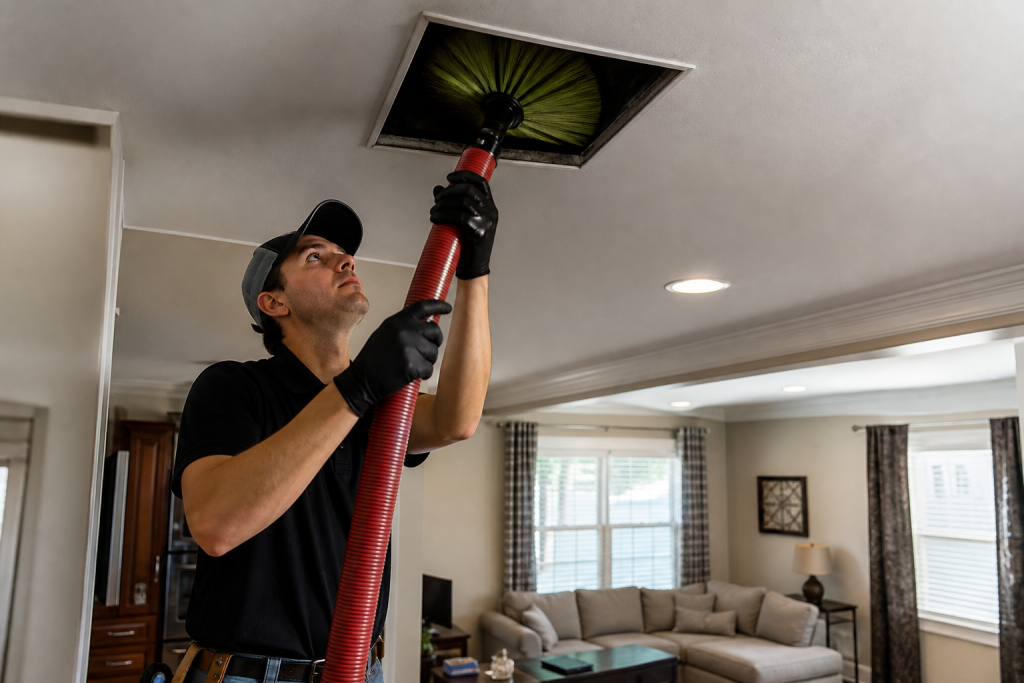
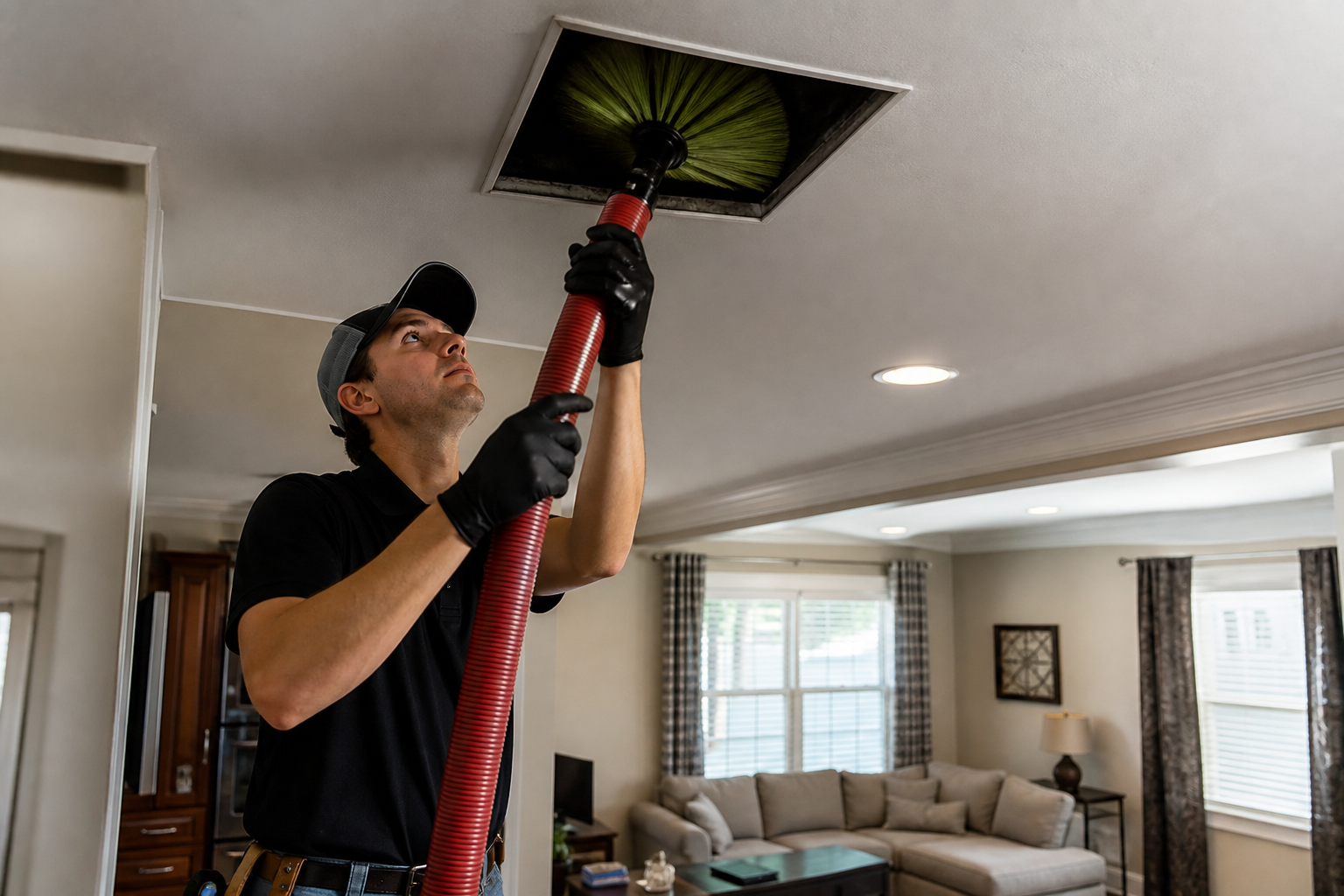
We use professional-grade Nikro and Rotobrush systems because they are built for containment. A standard household vacuum, no matter how powerful it looks, is not designed to handle the particulate matter involved in a true emergency.
How does Chicago’s housing stock complicate duct emergencies?
Chicago is unique. We have a mix of housing stock that you don’t see in the suburbs or other parts of the country. Many of our older homes, particularly the classic Chicago bungalows and two-flats, were built with galvanized steel ductwork that has been in place for 50, 60, or even 80 years.
In these older homes, the ductwork is often not fully sealed. You might have joist-panned returns, where the space between the floor joists acts as the duct. If you have a sewage backup in a basement, that unsealed space can act as a sponge for contaminants. Simply vacuuming the duct won’t fix it; that wood and masonry need to be professionally sanitized.
Furthermore, many Chicago homes have been retrofitted with various heating systems over the decades. We often find disconnected joints or collapsed sections inside the wall cavities. When we perform HVAC Cleaning in Chicago Lawn, we frequently see how these structural quirks make a simple cleaning job much more complex. If you have an emergency, tell the contractor if your home is an older build. It changes the equipment we need to bring and the amount of time we need to allocate for the job.
What is the difference between emergency cleaning and full remediation?
This is a distinction that saves our customers money. An “emergency cleaning” is a targeted effort to remove a specific source of contamination. “Remediation” is a broader, often destructive process where contaminated materials (like porous insulation, drywall, or mold-infested duct liner) are removed and replaced.
If you have a mold issue, for example, a duct cleaner cannot simply “clean” the mold away if the mold has colonized the insulation inside the duct. In that case, you need a remediation specialist first. If you call us, we will tell you honestly if we are the right first step or if you need to bring in a remediation firm before we can safely clean the system. We prioritize doing the job right over doing the job fast, which is why we have maintained a 4.9-star rating across 502 verified customer reviews.
If you are unsure which you need, give us a call. We can often guide you over the phone based on what you are seeing.
How to vet a contractor for an emergency call
When you are in a panic, it is easy to call the first number that pops up. This is how homeowners end up with “blow-and-go” companies that charge a low flat rate and do nothing but stir up the dust. When you call, ask these specific questions:
- “Will the owner be on-site?” I personally lead every job as the lead technician. You aren’t getting a subcontractor who is paid by the door.
- “Do you use HEPA-filtered equipment?” If they say they use a standard truck-mounted unit without mentioning HEPA filtration, be cautious. You want the contaminants extracted, not redistributed.
- “How do you handle older Chicago ductwork?” If they don’t ask about the age of your home or the type of ductwork, they aren’t thinking about the specific challenges of our local housing stock.
We use Abatement Technologies and Honeywell products for our sanitizing treatments because we know they work. When we handle Dryer Vent Cleaning in Chicago Lawn or full duct sanitization, we use the same professional-grade tools that industrial contractors rely on. It’s about accountability. When my name is on the business, I make sure the equipment is up to the task.
The Bottom Line
True air duct emergencies are rare, but they do happen. The most important thing to remember is to shut down your HVAC system, document the damage, and wait for a professional who understands the difference between a cleaning job and a remediation project. Do not let a low-bid contractor rush in and potentially make a contamination problem worse by turning on your system.
If you’re in Chicago and need help, Anchor Air Duct Cleaning Service Greater Chicago offers free estimates — call (833) 223-3823.
Frequently Asked Questions
It is almost always cheaper to clean and sanitize existing ductwork than to replace it, provided the structural integrity of the metal hasn’t been compromised by corrosion or fire damage. If your ducts are older, unlined galvanized steel, they are often robust enough to withstand a thorough professional cleaning and sanitizing, which is significantly more cost-effective than a full system replacement.
We prioritize true emergencies, such as sewage backups or post-fire contamination, but we are not an “emergency service” that operates on 24-hour dispatch. We are an owner-operated business, which means I personally lead every job. Please call (833) 223-3823 so we can discuss the severity of your situation and see how quickly we can get to your home.
In most cases, you do not need to leave your home, but we do ask that you stay out of the immediate work area, especially if we are dealing with hazardous materials like soot or sewage debris. We use high-powered extraction equipment that keeps the air in your home clean, but for safety reasons, it is best to keep pets and children away from the equipment and the vents while we are working.
A successful cleaning will result in the immediate elimination of the odor source and, in the case of soot or mold, visible cleanliness inside the ductwork. We encourage our customers to inspect our work. We are proud of our 4.9-star reputation built over 502 reviews, and we stand by our work by ensuring you are satisfied with the results before we pack up our gear.
Written by Ronald Cooper, Owner & Lead Technician at Anchor Air Duct Cleaning Service Greater Chicago, serving Chicago since 2015.
Need Air Duct Cleaning Help?
Call Anchor Air Duct Cleaning Service Greater Chicago — licensed & insured, here with fast after-hours help in Chicago.
(833) 223-3823