
Last updated September 3, 2026
How to Hire an Air Duct Cleaning Contractor in Chicago: A Step-by-Step Guide
Every few months, another round of “$49 whole-house duct cleaning” mailers lands in Chicago mailboxes — and every few months, homeowners who respond to them end up with a bill that looks nothing like the coupon. The Illinois Attorney General’s office has fielded complaints about bait-and-switch duct cleaning operations in the Chicago area for well over a decade, and the playbook these operations use hasn’t changed much. This guide will show you how to screen a contractor the way a building inspector would: with specific questions, verifiable credentials, and a clear picture of what a legitimate job actually looks like. By the end, you’ll know exactly what separates a real air duct cleaning company from one that treats your home as an opportunity.
Quick Answer
To hire a legitimate air duct cleaning contractor in Chicago, verify that the company holds active NADCA membership, uses professional-grade equipment with negative-pressure extraction (not a shop vac), and provides a written, itemized quote before any work begins. Ask specifically who will perform the work, what access method they use, and whether a before-and-after camera inspection is included — a legitimate contractor can answer all three without hesitation.
Table of Contents
- Why Chicago’s Duct Cleaning Market Is Especially Risky
- Credentials to Verify Before You Book
- The Screening Questions a Scam Operation Can’t Answer
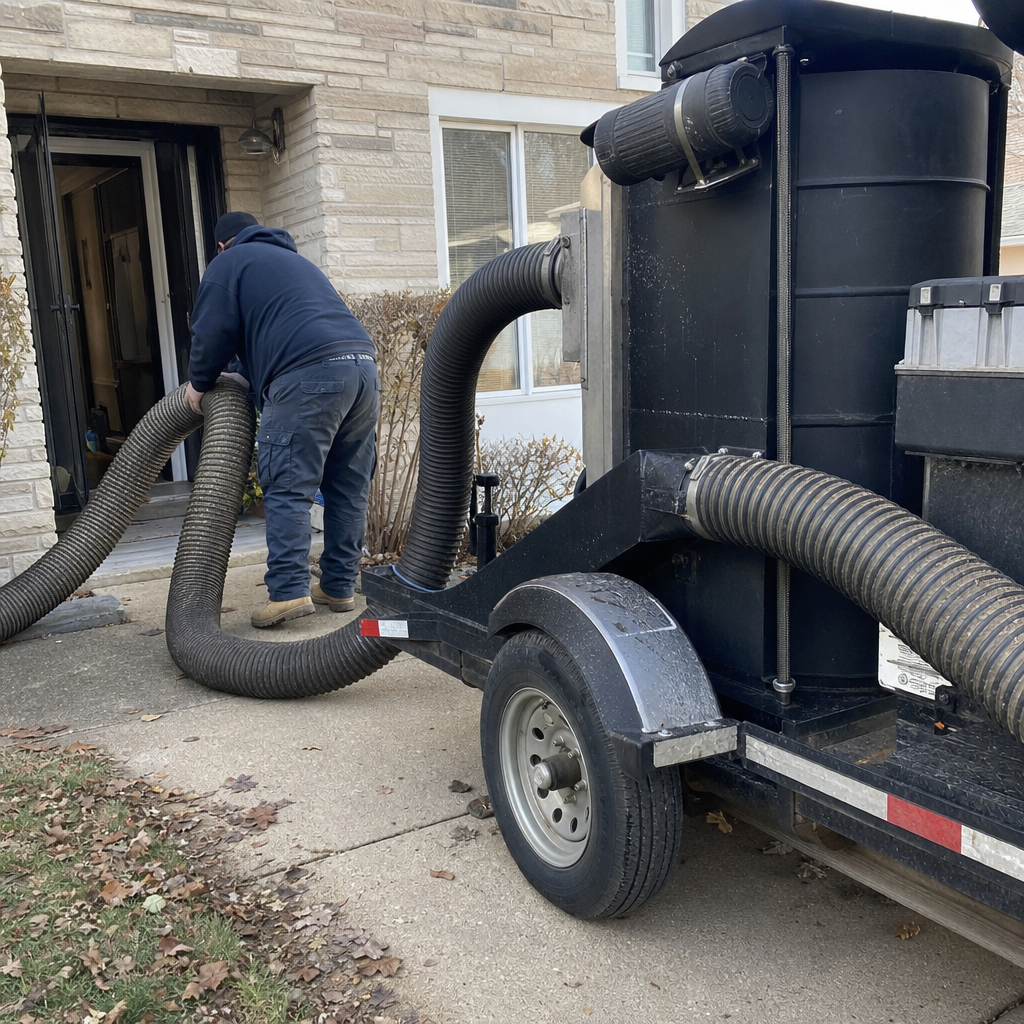
- What Equipment a Legitimate Contractor Should Use
- How to Evaluate Before-and-After Photos as Evidence
- Franchise Dispatcher vs. Owner-Operator: Why It Matters
- How to Cross-Check Reviews for Authenticity in Chicago
- What a Legitimate Duct Cleaning Job Should Look Like, Start to Finish
Why Chicago’s Duct Cleaning Market Is Especially Risky
Chicago’s housing stock creates specific conditions that make the duct cleaning market here more complicated than in newer cities. A large share of homes in neighborhoods like Bridgeport, Logan Square, and Beverly were built before 1970, many with original ductwork that hasn’t been professionally cleaned in years — or ever. That aging infrastructure is a genuine need, and predatory contractors know it.
The bait-and-switch model is well-established here: a company advertises a low flat-rate price for “whole-house duct cleaning,” arrives at your door, and then immediately identifies “mold,” “heavy contamination,” or “damaged ductwork” that requires expensive upsells — sometimes totaling $400 to $900 before they’ll finish the job. The Illinois Attorney General has received formal complaints about these operations under consumer fraud statutes, and the Better Business Bureau’s Chicago office has flagged similar patterns repeatedly.
What makes Chicago particularly vulnerable is the density of fly-by-night operations that use local phone numbers and Chicago-area addresses in online listings while actually dispatching crews from hours away. They’re optimized for Google Maps visibility, not service quality. The good news is that their tactics leave identifiable fingerprints — and once you know what to look for, they’re not hard to spot.
Chicago’s climate also creates legitimate duct cleaning needs that a good contractor should understand, as covered in our Seasonal Air Duct Cleaning Care for Chicago: Year-Round Homeowner’s Guide. Older homes with steam heat that were later converted to forced air, homes near the lakefront that deal with higher humidity infiltration, and houses in neighborhoods with heavy tree cover that affects outdoor air quality — these are real local factors that shape how your ducts accumulate debris. A contractor who can’t speak to any of that hasn’t been doing this work in Chicago.
Credentials to Verify Before You Book
NADCA — the National Air Duct Cleaners Association — sets the industry standard for duct cleaning procedures and requires member companies to employ at least one ASCS (Air Systems Cleaning Specialist) certified technician. NADCA certification matters, but it isn’t a complete screening on its own. Membership can lapse, technician certifications expire, and some companies list NADCA affiliation in their marketing without maintaining active status.
Here’s how to verify it correctly:
- Go directly to NADCA.com and use the “Find a Member” search. Type the company name or Chicago ZIP code and confirm the company appears as an active member — not just that they claim it on their website.
- Confirm Illinois business registration. Search the Illinois Secretary of State’s business database at ilsos.gov to verify the company is registered to operate in Illinois. Out-of-state operators running Chicago-area scams frequently don’t appear here.
- Verify insurance independently. Ask for a certificate of insurance and call the insurer directly to confirm the policy is active. General liability coverage protects your home if equipment damages your ducts or property during the job.
- Check the BBB Chicago profile. Look for complaint history, not just a rating — a B+ rating with six unresolved complaints in the last year tells you more than the letter grade alone.
- Confirm a physical Chicago-area business address. Google the address independently. A residential home, a UPS Store mailbox, or a non-existent street number is a hard red flag.
NADCA certification is the floor, not the ceiling. A company can be NADCA-certified and still deliver a poor job if their equipment is inadequate or their technicians are undertrained. Credentials tell you a contractor is serious — they don’t tell you the job will be done right. That’s what the next section is for.
The Screening Questions a Scam Operation Can’t Answer
Before you book any duct cleaning appointment in Chicago, ask these questions on the phone or by email. A legitimate operation answers them confidently and specifically. A bait-and-switch operation will hedge, redirect, or give you vague answers designed to get the crew in your door before the real conversation begins.
- “What equipment will you use, and how does it create negative pressure in the duct system?” A real contractor explains the negative-pressure extraction process — a high-powered vacuum is connected to the main trunk line to create suction throughout the system while mechanical agitation (brushes or air whips) dislodges debris. If they say “we use a high-powered vacuum” and can’t explain the agitation component, the job won’t be done to NADCA standard.
- “How do you access the ductwork — cuts in the trunk line or through the registers only?” Legitimate cleaning typically requires cutting access panels into the main trunk lines so the vacuum hose can be connected properly. A company that claims to clean through the registers alone is not performing a complete job.
- “What’s included in the quoted price, and what would cause the price to change?” Get a written answer. A legitimate company will tell you exactly what triggers a price adjustment (e.g., dryer vent cleaning is a separate service, or if your system has more than a certain number of registers). An evasive answer here is a near-certain sign of an upsell operation.
- “Who specifically will be performing the work — a company employee or a subcontractor?” Franchise operations frequently dispatch independent subcontractors who are paid per job. The incentive structure for a subcontractor is speed, not quality.
- “Do you include a camera inspection before and after cleaning?” A real contractor can show you the duct interior before the job begins and after it ends. If a company resists showing you documented evidence, ask yourself what they don’t want you to see.
In our experience across eleven years of Chicago-area jobs, the companies that stumble on question three — what’s included and what changes the price — are almost always the ones that generate the complaints you’ll later read on the AG’s consumer fraud page.
What Equipment a Legitimate Contractor Should Use
The equipment gap between a legitimate air duct cleaning contractor and a low-bid operation is significant, and it’s one of the clearest ways to separate the two before anyone sets foot in your home.
NADCA’s ACR standard (Assessment, Cleaning, and Restoration) requires that duct cleaning be performed using a source removal method: the duct system is put under continuous negative pressure, and a mechanical agitation device dislodges debris while the vacuum pulls it out. The vacuum unit needs to generate enough airflow to handle the full volume of your duct system — residential systems vary considerably based on house size and duct layout, but an undersized unit simply won’t do the job.
Professional-grade systems used on commercial and industrial jobs — equipment like Rotobrush and Nikro — are designed for exactly this kind of work. They combine high-powered extraction with rotating brush agitation and are built to handle both flexible and rigid ductwork. When a contractor shows up with consumer-grade shop vacuums and handheld brushes, they are not performing source removal cleaning. They are performing something that looks like duct cleaning and costs less because it accomplishes less.
Ask the contractor specifically: “What is the make and model of your main extraction unit, and what is its airflow capacity?” A legitimate contractor knows this answer. If the response is “we use a commercial-grade vacuum” with no specifics, probe further or move on.
Also ask whether they carry sanitizing products for post-cleaning treatment. Products like those from Honeywell or Aprilaire are used in the ductwork after cleaning to address microbial growth — relevant in Chicago homes where humidity infiltration has been an issue. A contractor who offers this service but can’t name the products they use is improvising.
How to Evaluate Before-and-After Photos as Evidence
Nearly every duct cleaning company in Chicago now posts before-and-after photos online. The problem is that most of those photos tell you almost nothing about the quality of the work. Here’s how to read them as evidence rather than marketing material.
What a useful before-and-after image should show:
- A consistent camera angle and location so you can compare the same section of duct before and after — not two different areas of the duct system photographed at different angles.
- Visible duct walls and corners, not just the opening of a register. Register openings can look clean even when the duct walls behind them are coated in debris.
- Lighting that illuminates the full interior — a dark “after” photo that you can barely make out is not evidence of a clean duct.
- Debris in the “before” image that reflects the type of contamination common to that home — pet dander, construction dust, and mold growth look different from each other. Generic “dark and dirty” before photos that look identical across every customer review are often stock or recycled.
What to ask about photos during the booking call:
- “Do you use a camera inspection scope, and will you show us the footage before and after the job?”
- “Are the photos on your website from actual Chicago-area jobs, and can you show us samples from homes with similar ductwork to ours?”
In Chicago’s older housing stock — bungalows in Garfield Ridge, two-flats in Pilsen, greystones in Lincoln Square — the ductwork configurations vary considerably from the newer suburban construction where most national franchise photos are taken. A contractor who actually works in Chicago regularly will have photos from Chicago homes, not generic suburban interiors.
Franchise Dispatcher vs. Owner-Operator: Why It Matters
When you hire a franchise duct cleaning company, you are typically hiring a brand, not a specific person. The person who answers the phone is a dispatcher or salesperson. The person who shows up at your door may be an employee of a local franchise owner — or, in some cases, an independent subcontractor hired to fulfill that day’s appointments. The franchise owner may never see your home or know how the job went unless you call to complain.
This structure creates a specific accountability gap. If the job is done poorly — debris left in the ductwork, equipment damage to your ducts, an upsell that wasn’t disclosed on the phone — you’re dealing with a customer service department whose job is to protect the brand, not necessarily to make things right for you.
An owner-operator model works differently. When the owner is the person running the equipment, their name is on every job in a way that actually means something. They know the equipment, they set the standards, and they’re accountable to their own reputation — not to a franchise call center.
At Anchor Air Duct Cleaning Service Greater Chicago, Ronald Cooper leads every job personally. He’s not dispatching crews while managing a franchise — he’s the technician. Over eleven years and 502 verified customer reviews, that model has produced a 4.9-star average not because of a marketing strategy, but because the person whose name is on the business is the person doing the work.
When you’re evaluating any contractor, ask directly: “Will the owner or a company employee perform the work, or do you use subcontractors?” The answer tells you a great deal about what happens if something goes wrong.
How to Cross-Check Reviews for Authenticity in Chicago
Chicago’s duct cleaning market has a review manipulation problem. Some operations in the area have been flagged for clusters of five-star reviews posted within days of each other, reviews from accounts with no location history, and suspiciously similar language across multiple reviews. Here’s how to evaluate reviews like a skeptic.
Signs of authentic reviews:
- Reviews mention specific details — the technician’s name, a particular neighborhood, a specific problem that was diagnosed or resolved. Generic praise (“great service, very professional, would recommend”) is easy to manufacture.
- The reviewer has a history of reviewing other local businesses. A Google account with one review ever posted is a weaker signal than one that has reviewed a dozen Chicago businesses over several years.
- The review spread is consistent over time — a company with 500 reviews that mostly arrived in two clusters has a different story to tell than one that has built steadily over a decade.
- One-star and two-star reviews exist and have genuine, specific responses from the company. A profile with zero negative reviews across hundreds of reviews is statistically unusual.
Cross-checking sources:
- Compare the Google Business Profile review count to Yelp and the BBB. Huge discrepancies — 400 Google reviews and 3 on Yelp — can indicate a managed or incentivized review campaign on one platform.
- Search the company name plus “complaint” or “scam” on Google. Illinois AG complaint records are public, and consumer forums sometimes surface patterns that review platforms don’t catch.
- Check whether the company’s address matches its service area. If a company lists a Chicago address but all their detailed reviews mention suburbs 30 miles out, something doesn’t add up.
What a Legitimate Duct Cleaning Job Should Look Like, Start to Finish
Knowing the correct sequence of a professional duct cleaning job lets you verify in real time whether the contractor you hired is doing it right — or cutting corners.
- Pre-job inspection and documentation. Before any equipment is connected, the technician should inspect the accessible ductwork, note the system configuration, and photograph or video the interior condition of the ducts. This is the “before” record.
- System access cuts. The technician cuts access openings in the main supply and return trunk lines — this is where the vacuum hose connects to create negative pressure throughout the system. These cuts are later sealed with sheet metal patches and foil tape. If no cuts are made, no legitimate negative-pressure cleaning is happening.
- Vacuum connection and negative pressure establishment. The extraction unit is connected and running before agitation begins. The duct system should be under continuous negative pressure for the duration of cleaning — this prevents dislodged debris from being redistributed into your living space.
- Mechanical agitation of each branch duct. Using rotating brushes or air whips introduced through the registers, the technician works through each supply and return branch, dislodging debris that is then pulled toward the vacuum connection. This is done register by register — a legitimate job on a typical Chicago bungalow with 10–14 registers takes two to three hours, not forty-five minutes.
- Main trunk cleaning. After the branch runs are cleared, the main trunk line itself is cleaned using larger brush heads or air tools introduced through the access cuts.
- Post-cleaning inspection and documentation. A camera inspection of the duct interior is performed and documented. The technician shows you the results. This is the “after” record that protects both of you.
- Access cut sealing. The access openings are patched and sealed with sheet metal and foil tape that meets HVAC code. They should be airtight — not covered with duct tape alone, which degrades and fails over time.
- Optional sanitizing treatment. If the pre-job inspection identified microbial growth or if the homeowner requests it, an EPA-registered sanitizing agent is applied to the duct interior. Products such as those from Honeywell and Aprilaire are formulated for HVAC duct application — not consumer spray bottles.
For homeowners in Chicago’s older bungalow belt — Austin, Avondale, Back of the Yards — ductwork is frequently a patchwork of original and retrofitted sections, and a thorough job may take longer than it would in a newer home with a cleaner layout. A contractor who quotes a flat time regardless of your home’s configuration isn’t accounting for the real variables.
If you’re also dealing with dryer vent buildup — common in Chicago’s two-flats and coach houses where dryer runs are longer than in single-family homes — that’s a separate service. Our Dryer Vent Cleaning in Chicago Lawn page covers what that inspection and cleaning process looks like, including the fire risk factors specific to longer vent runs.
Common Mistakes to Avoid
- Booking based on price alone. The $49 coupon price has been bait for Chicago homeowners for years — the final bill from those operations routinely runs six to ten times the advertised amount once “required” upsells are added. Get an itemized written quote before booking, not after the crew arrives.
- Skipping independent credential verification. Checking a company’s website for a NADCA logo is not verification — logos can be outdated or fabricated. Always verify active membership directly on NADCA.com and confirm Illinois business registration on ilsos.gov.
- Not asking who will physically do the work. Franchise networks and large multi-crew operations frequently dispatch whoever is available that day. Knowing whether you’re getting a trained company employee or a subcontractor working on commission changes what you should expect.
- Accepting a quote over the phone without asking what’s excluded. A quote that doesn’t explicitly address how many registers are covered, whether the main trunk is included, and what triggers a price change is not a real quote. In Chicago’s older homes with non-standard duct configurations, this matters more than in newer construction.
- Ignoring review patterns in favor of star averages. A 4.8-star average with 22 reviews tells you far less than a 4.9-star average with 500 reviews built consistently over a decade. Volume and time-distribution of reviews matter as much as the number itself.
- Scheduling without asking about equipment. A company that can’t tell you the brand and model of their extraction unit, or that describes their equipment as “high-powered vacuums” without explaining the negative-pressure process, is not equipped to perform a NADCA-standard cleaning.
- Overlooking dryer vent and HVAC cleaning as separate scopes. Some homeowners assume duct cleaning covers the entire HVAC system including the air handler and dryer vent — it doesn’t. Clarify exactly what scope of work is covered to avoid surprises. Our HVAC Cleaning in Chicago Lawn page explains what a proper HVAC unit cleaning involves and why it’s a distinct service.
When to Call a Professional
Some situations in Chicago homes warrant professional duct cleaning without hesitation — waiting or attempting a DIY approach makes them worse, not better.
- You’ve recently completed a renovation in any room of the house — construction dust infiltrates ductwork extensively and circulates long after the visible mess is cleaned up. This is especially common in Chicago’s older greystone and brick-two-flat renovations.
- You or a household member has experienced unexplained allergy or asthma symptoms that worsen at home but improve when away.
- You’ve moved into a home where the duct cleaning history is unknown — particularly relevant in Chicago’s active resale market where homes frequently change hands after years of deferred maintenance.
- You can see visible debris, dust buildup, or discoloration around supply registers.
- Your home has a musty odor when the HVAC system runs that doesn’t respond to filter changes.
Anchor Air Duct Cleaning Service Greater Chicago offers free estimates across Chicago — Ronald Cooper will assess your system and tell you honestly whether cleaning is warranted and what the job will involve. Call (833) 223-3823 to schedule.
Frequently Asked Questions
A legitimate whole-house air duct cleaning in Chicago typically ranges from $300 to $600 for a standard single-family home, depending on system size, number of registers, and duct configuration. Quotes significantly below that range — particularly those under $150 — almost always reflect either an incomplete scope of work or the first step in a bait-and-switch upsell. Get a written, itemized quote that specifies exactly what’s included before you book. Call (833) 223-3823 for a free estimate with no obligation.
A thorough duct cleaning on a typical Chicago single-family home takes two to four hours, depending on system size and duct condition. Older homes in neighborhoods like Bridgeport or Portage Park with patchwork duct systems often take longer than newer construction. A job completed in under an hour on a full-size home almost certainly wasn’t done to NADCA standard — mechanical agitation of each branch duct takes time that can’t be cut without cutting quality.
NADCA certification is a meaningful baseline — it confirms the company employs a trained technician and has agreed to NADCA’s cleaning standards. But it isn’t a complete guarantee. Membership can lapse, and certification doesn’t tell you whether the contractor uses adequate equipment, employs their own technicians, or has a history of consumer complaints. Verify NADCA membership directly on NADCA.com, cross-check on the BBB, and ask the screening questions in this guide before booking — or use our Air Duct Cleaning Maintenance Checklist for Chicago Homeowners to stay organized.
Yes — and you should insist on it. A legitimate contractor uses a camera inspection scope and can show you the interior condition of your ducts before work begins and after it’s complete. This documentation protects you and confirms the job was done. If a contractor resists showing you pre- and post-cleaning inspection footage, that’s a significant red flag regardless of what their website claims.
Duct cleaning refers specifically to cleaning the supply and return duct system — the metal pathways that carry conditioned air throughout your home. HVAC cleaning addresses the mechanical components of the system itself: the air handler, evaporator coil, blower wheel, and drain pan. These are distinct services with different processes and equipment. In many Chicago homes, both need attention, but they’re often quoted and performed separately. Our Air Duct Cleaning in Chicago Lawn page explains the full duct cleaning scope in detail.
NADCA’s general recommendation is every three to five years under normal conditions, but Chicago homes often warrant more frequent cleaning. Older construction with original ductwork, homes with pets, recent renovation work, or homes in areas with high outdoor particulate levels may benefit from cleaning every two to three years. If you’re unsure, a camera pre-inspection — before committing to a cleaning — can tell you objectively whether the system needs it.
The Bottom Line
Hiring an air duct cleaning contractor in Chicago correctly means verifying credentials directly (not just reading a website), asking specific technical questions before any crew arrives, understanding what legitimate equipment looks like, and knowing the difference between a franchise dispatcher and the person who actually shows up at your door. For more guides & resources on protecting your home, explore our blog. The bait-and-switch operations in this market are predictable and avoidable — they can’t answer the screening questions in this guide because their model depends on you not asking them. A contractor with 11 years of specialized experience, professional-grade Rotobrush and Nikro equipment, and 502 verified reviews at 4.9 stars isn’t hiding from those questions. They’re built on them.
Ready to schedule? Call Anchor Air Duct Cleaning Service Greater Chicago at (833) 223-3823 for a free estimate. Ronald Cooper will assess your system, answer every question in this guide, and give you a written quote before any work begins.
Written by Ronald Cooper, Owner & Lead Technician at Anchor Air Duct Cleaning Service Greater Chicago, serving Chicago since 2015.