
Last updated July 11, 2026
Seasonal Air Duct Cleaning Care for Chicago: Year-Round Homeowner’s Guide
Most Chicago homeowners schedule air duct cleaning once — usually sometime in spring — check it off the list, and don’t think about it again. That single-event approach made sense when duct cleaning was a novelty. It doesn’t hold up once you understand what Chicago’s climate actually does to your duct system across four genuinely different seasons. Chicago runs its furnace hard from October through April, then pivots to central air in a three-week window while half the city has their windows open. That transition is when ducts absorb the most outdoor particulate of the entire year — and almost nobody cleans before it. This guide will walk you through what each season does to your duct system, what to watch for month by month, and when the timing of a cleaning actually changes what you get out of it.
Quick Answer
Chicago homeowners get the most value from air duct cleaning in late September — just before heating season begins — not in spring as most guides suggest. Chicago’s climate creates four distinct contamination cycles: summer basement humidity breeds condensation inside return ducts, the fall transition deposits outdoor particulates before the furnace runs continuously, winter high-runtime heating redistributes fine debris throughout the system, and spring pollen season loads the return air path during the window-open HVAC switchover. Treating duct care as a single annual event means you’re perpetually addressing last season’s problem instead of preventing the next one.
Table of Contents
- Why Chicago’s Climate Creates Unique Duct Conditions
- Fall: Why Late September Is the Highest-Value Cleaning Window
- Winter: What Happens to Duct Debris When Your Furnace Runs All Day
- Spring: Open Windows, Pollen Season, and the HVAC Switchover Problem
- Summer: Basement Humidity, Condensation, and Return Duct Mold Risk
- Month-by-Month Reference Card for Chicago Homeowners
- Common Mistakes to Avoid
- When to Call a Professional
- Frequently Asked Questions
- The Bottom Line
Why Chicago’s Climate Creates Unique Duct Conditions
Chicago doesn’t have mild seasons — it has extreme ones. January averages in the low teens Fahrenheit while July humidity regularly pushes the heat index above 100°F. That swing creates mechanical and biological stresses on a duct system that homeowners in moderate climates simply don’t face. Understanding those stresses is the foundation of intelligent duct maintenance.
Three factors make Chicago’s duct environment distinct:
- Heating season length: Chicago furnaces typically run from mid-October through early April — roughly 170 days. That’s not just a long season; it’s 170 days of continuous particulate redistribution through your duct system every time the blower kicks on.
- Basement construction: The overwhelming majority of Chicago’s residential housing stock — bungalows in Portage Park, two-flats in Logan Square, colonials in Beverly — puts the furnace and return air ducts in an unconditioned or semi-conditioned basement. Basement air is fundamentally different from the air upstairs, and it gets pulled into the return system every time the system runs.
- The lake effect: Lake Michigan moderates temperatures but adds persistent humidity in late summer and early fall, exactly when duct systems are sitting idle between cooling and heating seasons. Idle ducts in humid air are not neutral — they’re incubating.
In our 11 years working through Chicago neighborhoods from Rogers Park to Mount Greenwood, we’ve seen these conditions consistently translate into heavier debris loads, more frequent condensation issues, and more significant filter bypass than what national guidelines assume. The national recommendation of cleaning every three to five years is calibrated for average conditions. Chicago is not average.
Fall: Why Late September Is the Highest-Value Cleaning Window
Here is the counterintuitive truth that most duct cleaning guides — and many of our competitors — miss entirely: late September to mid-October is the single most valuable cleaning window for Chicago homes, not spring.
Here’s the logic. By late September, your air conditioning has been off for a few weeks. The duct system has been sitting with residual humidity from the summer cooling cycle, which means any particulate that settled on duct surfaces has had time to bind and compact. More importantly, you haven’t turned the furnace on yet. The moment you do — and in Chicago, the first cold snap can hit fast — the blower motor forces air through every inch of that duct system at high velocity. Whatever has accumulated over the summer gets mobilized immediately and distributed through every register in the house.
A late September cleaning captures that accumulated summer debris before the furnace reactivates it. You enter heating season with clean ducts, which means:
- The first furnace run of the season doesn’t spike your indoor particle count.
- Your filter isn’t starting the heating season already partially loaded.
- Any condensation-related growth from summer basement humidity gets extracted before it has 170 days of warm airflow to dry, spread, and redistribute.
- Your Honeywell or Aprilaire whole-home air purifier — if you have one — starts the season on a clean system rather than fighting upstream contamination from day one.
By contrast, a spring cleaning happens after the heating season has already run its course. You’re cleaning up last season’s mess rather than preventing next season’s exposure. Spring cleaning has value — don’t skip it entirely — but if you’re choosing one annual cleaning for a Chicago home, late September wins.
Winter: What Happens to Duct Debris When Your Furnace Runs All Day
During a typical Chicago January, a furnace in a well-insulated home might run six to eight hours per day. During a polar vortex event — the kind Chicago sees every few winters — that number climbs to ten hours or more. That runtime has a direct effect on indoor air quality that most homeowners don’t think about.
Every time the blower runs, it creates airflow turbulence inside the duct system. Fine particulates — skin cells, pet dander, fine dust, mold fragments — that have settled on duct walls get re-entrained into the airstream and delivered through your supply registers. In a clean duct system, this effect is minor. In a system with significant debris accumulation, high-runtime winter operation essentially turns your duct work into a continuous particle broadcast system.
We regularly measure this effect when we inspect systems in Bridgeport, Edgewater, and Lincoln Square: homes with older debris loads show noticeably higher surface dust accumulation in the living areas during heating season, and residents often describe increased respiratory irritation that improves when weather allows them to open windows — not because the cold air is better, but because the duct system stops running.
Winter is not the right time to clean ducts — you don’t want to open your system to the cold, and scheduling is constrained — but it is the right time to watch for warning signs:
- Visible dust discharge from supply registers shortly after the furnace starts
- Musty or stale odors on first heat cycles of the day
- Filter loading faster than normal (check every 30 days in winter)
- Household members with more allergy or sinus symptoms indoors than outdoors
If you’re seeing any of these signs by February, put a late September cleaning on your calendar now and don’t wait for spring to address it.
Spring: Open Windows, Pollen Season, and the HVAC Switchover Problem
Chicago spring arrives abruptly — a few 50-degree days in late March, then a week in the 70s in April, and suddenly everyone has their windows open. That’s exactly when the tree pollen count in the Chicago metro peaks, typically running high from mid-April through late May. Oak, maple, and elm pollen blanket the city, and much of it finds its way through open windows directly into your return air pathway.
The return air pathway is the part of your duct system that pulls air back from the living space to the air handler. In most Chicago homes, return grilles are located in hallways, stairwells, or living areas — precisely where open-window cross-breezes flow. Every hour those windows are open with the blower running (even just the fan, not the full heating or cooling cycle), your return ducts are collecting whatever is in that outdoor air.
The switchover itself compounds the problem. The period between shutting off the furnace and starting the AC — typically two to four weeks in Chicago — is when the duct system is most vulnerable to unfiltered air exposure. The furnace filter is still in place, but the system pressure dynamics change, and it’s common for filter bypass to occur around a filter that wasn’t seated perfectly.
Spring duct care priorities:
- Replace your furnace filter the day you switch from heat to fan/cooling mode — don’t run the spring season on a winter-loaded filter.
- Inspect return grilles for visible pollen or dust accumulation — a thin yellow-green coating on the grille face is a clear indicator of return duct loading.
- If you have a UV air purification system or Honeywell media cabinet, schedule its annual media replacement before cooling season begins.
- If you skipped the fall cleaning, spring is your catch-up window — schedule before Memorial Day, not after.
For Chicago homeowners in neighborhoods like Andersonville or Hyde Park with older housing stock and original ductwork, spring is also a good time to have duct sealing evaluated. Leaky ducts in spring don’t just waste conditioned air — they pull unconditioned attic or basement air, loaded with whatever those spaces contain, directly into your living environment.
Summer: Basement Humidity, Condensation, and Return Duct Mold Risk
This is the section most duct cleaning guides skip entirely, and it’s one of the more serious seasonal risks for Chicago homeowners specifically.
Chicago summers are humid. Dew points regularly hit the 70s°F in July and August, which means basement air can carry substantial moisture. When that humid basement air contacts the cool metal surfaces of return air ducts — which have been chilled by the air conditioning system running through them — condensation forms on the exterior and sometimes the interior of the duct walls. This is physics, not a maintenance failure, but it creates conditions that accelerate mold colonization if the ductwork has any surface debris to feed on.
Return air ducts in Chicago basements are particularly susceptible because they’re often oversized for the actual return air volume, which means there are low-velocity dead zones inside the duct where moisture and debris accumulate together. We’ve pulled debris from return trunk lines in Pilsen and Wicker Park that showed clear signs of biological growth — growth that had been slowly releasing spores into the return airstream all summer long before the homeowner noticed anything.
Summer duct care isn’t about scheduling a cleaning — it’s about prevention and monitoring:
- Run a dehumidifier in the basement if your AC isn’t maintaining below 55% relative humidity down there. A standalone unit or a whole-home Aprilaire dehumidifier both work; the goal is eliminating the moisture that feeds condensation on duct surfaces.
- Inspect return duct access panels in the basement once in July — look for any dark staining, musty smell, or visible moisture on duct surfaces.
- If you notice a musty smell from registers when the AC runs in July or August, don’t wait until fall. That’s a signal worth investigating before it intensifies.
- Ensure basement duct insulation is intact — bare metal ducts in humid basements condense faster than insulated ones.
If a summer inspection turns up visible biological growth, that’s not a situation to defer. Air quality sanitizing — using products like Guardsman antimicrobial treatments applied through the duct system — is appropriate here, and it should be paired with a full extraction cleaning to remove the substrate that growth was feeding on.
Month-by-Month Reference Card for Chicago Homeowners
Use this as a practical reference, not a rigid schedule. Chicago weather varies year to year — adjust the timing when seasons run early or late.
- January–February: Monitor filter loading (check monthly). Watch for visible dust discharge from supply registers. Note any odors on furnace startup. No cleaning needed unless warning signs are present.
- March: Begin planning spring HVAC transition. Order replacement filters now so you have them on hand. Check basement duct insulation condition before humidity season begins.
- April: Replace furnace filter when switching to fan/cooling mode. Inspect return grilles for pollen accumulation. If skipping fall cleaning, book spring cleaning before May.
- May: Complete any deferred spring duct cleaning before Memorial Day. Ideal window for dryer vent cleaning — lint accumulation from the heating season is at its peak. Check dryer vent termination at the exterior wall for bird nest activity (this is a real issue in Chicago’s bungalow belt).
- June: Start monitoring basement humidity. If relative humidity exceeds 55%, deploy dehumidification. Confirm AC is running efficiently — a struggling AC system runs longer and creates more condensation inside the air handler.
- July–August: Inspect basement return ducts visually. Run whole-home dehumidifier if available. If musty odors appear from registers, call for an inspection — don’t defer to fall.
- September: Priority cleaning window. Schedule duct cleaning before the first heating cycle. This is the highest-value timing for Chicago homes. Also ideal for HVAC cleaning — coil and blower cleaning before the furnace takes over.
- October: Test furnace before first cold night. Replace filter at season start if not done in September. Confirm carbon monoxide detectors are functional.
- November–December: Check filter monthly. Note any changes in airflow from registers. Plan spring booking early — September slots fill fast.
Common Mistakes to Avoid
- Scheduling your only annual cleaning in spring and calling it done. Spring cleaning addresses last winter’s contamination, not the coming heating season’s exposure. Chicago’s fall transition window — late September — is where a cleaning prevents the most harm per dollar spent.
- Ignoring the basement humidity problem until you smell something. Mold in return ducts doesn’t announce itself immediately. By the time you notice a musty odor from registers in a Chicago home, biological growth has typically been present for weeks or months. Monthly visual checks on basement ductwork during June through August costs nothing.
- Running the same filter through heating season without monthly checks. A Chicago furnace running 6–8 hours daily in January loads filters faster than the packaging’s “replace every 90 days” guidance assumes. A clogged filter doesn’t just reduce air quality — it stresses the blower motor and accelerates debris bypass into the duct interior.
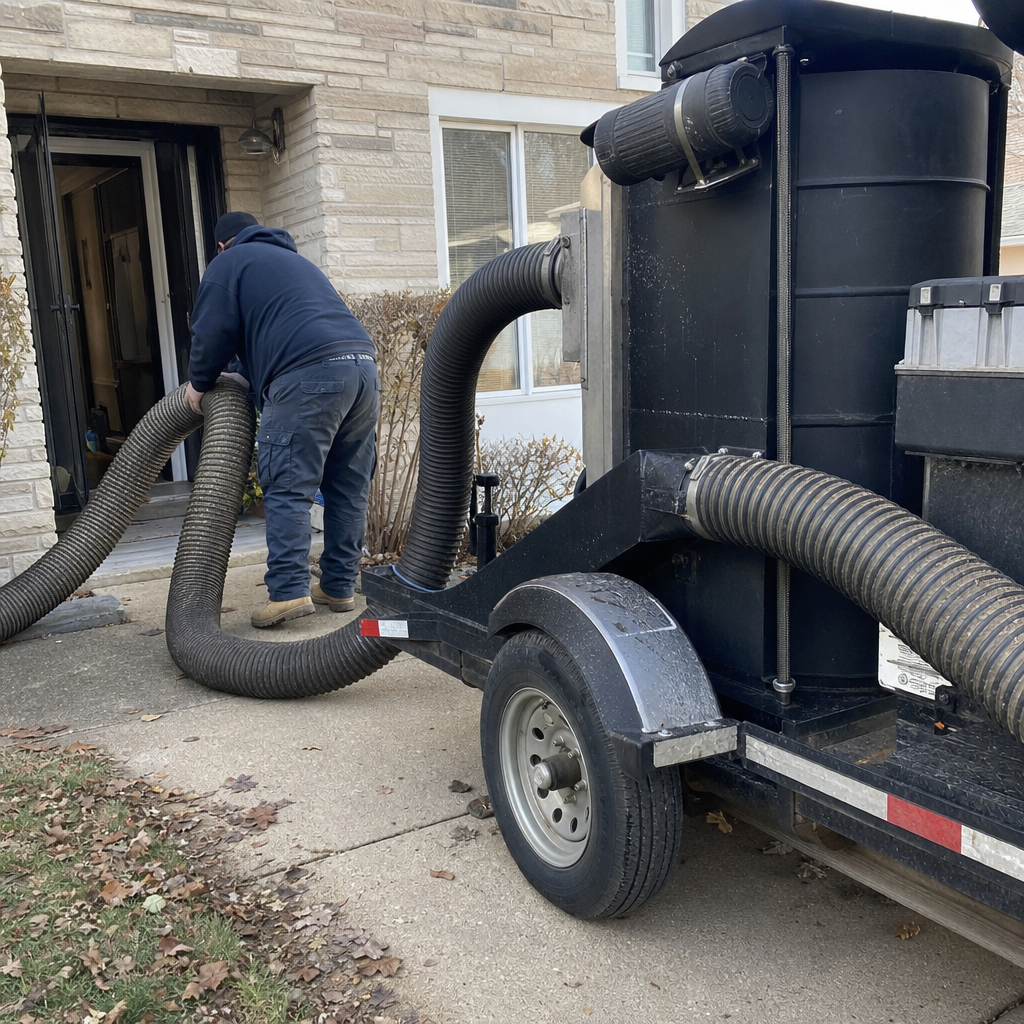
- Assuming all duct cleaning services use the same equipment. A shop vac connected to a register opening does not constitute professional duct cleaning. Systems like Rotobrush and Nikro — the equipment Anchor operates — mechanically agitate debris from duct walls while simultaneously extracting it under negative pressure. The difference in debris removal volume is not marginal.
- Skipping the dryer vent as part of seasonal duct care. Dryer vents run through the same wall cavities and termination points as HVAC ductwork. A lint-blocked dryer vent in a Chicago bungalow is a fire risk that accumulates specifically during long heating seasons when laundry volumes increase. May, after heating season, is the natural scheduling window.
- Deferring duct sealing on older Chicago housing stock. Many Chicago two-flats and bungalows have original ductwork with poorly sealed joints. Leaky ducts in winter pull cold basement air into the supply path, reducing efficiency and drawing in basement particulates. Sealing those joints is a one-time fix with multi-year payback — it’s not a luxury service on a 1940s-era duct system.
- Using air fresheners or sprays to address register odors instead of finding the source. Masking a musty or dusty smell from registers doesn’t eliminate what’s causing it. In our experience, homeowners in Lincoln Park and Andersonville who’ve used in-duct fragrance products for years are often surprised to find what’s actually inside the system when we open it up. Treat the source, not the symptom.
When to Call a Professional
Some duct maintenance tasks belong on your own monthly checklist — filter changes, humidity monitoring, visual grille inspections. Others cross into territory where DIY effort either doesn’t reach the problem or risks making it worse.
Call a professional when:
- You notice visible debris discharge from supply registers after furnace startup
- Return grilles show dark staining or musty odor that persists after cleaning the grille face
- You’ve gone more than three years without a professional cleaning in a Chicago home with pets, smokers, or recent renovation work
- You find visible moisture staining or biological growth on accessible duct surfaces in the basement
- Airflow from one or more registers has noticeably decreased without an obvious filter explanation
- You’re preparing a Chicago home for sale or moving into a previously occupied home with no cleaning history
Anchor Air Duct Cleaning Service Greater Chicago offers free estimates throughout Chicago — Ronald Cooper leads every job personally, which means the person assessing your system is the same person who will clean it. Call (833) 223-3823 to schedule.
Frequently Asked Questions
Most Chicago homes benefit from professional air duct cleaning every two to three years, though homes with pets, allergy sufferers, smokers, or recent renovation work often need cleaning on a two-year cycle. Chicago’s long heating season and basement humidity conditions accelerate debris accumulation compared to national averages, so the generic “every three to five years” guidance from national bodies tends to underestimate local needs. If you’re unsure, a free inspection will tell you what’s actually in the system. Call (833) 223-3823 to schedule one.
Late September is the best single window for Chicago homes — after summer humidity has passed and before the furnace begins its 170-day heating run. Cleaning at this point captures summer debris accumulation and condensation-related buildup before the heating season mobilizes and redistributes it throughout the house. Spring is a valid secondary window if fall cleaning isn’t feasible, but it addresses last season’s damage rather than preventing next season’s exposure.
Yes, and it’s more common in Chicago than in drier climates specifically because of basement humidity during summer. Return air ducts in unconditioned Chicago basements are regularly exposed to dew points above 70°F in July and August. When those humid conditions contact cooled duct metal, condensation forms — and if surface debris is present, biological growth follows. The solution is a combination of source-control dehumidification and professional extraction cleaning with antimicrobial treatment when growth is confirmed.
Professional duct cleaning — using mechanical agitation and negative-pressure extraction rather than simple vacuuming — measurably reduces the particulate load inside the duct system and the debris available for recirculation. The key word is “professional.” Equipment like Rotobrush and Nikro systems mechanically dislodge material from duct walls while simultaneously extracting it under negative pressure; that process is fundamentally different from a vacuum hose inserted at a register. Homeowners who’ve had a legitimate cleaning done consistently report reduced surface dust accumulation and improved filter efficiency in the months that follow.
Before — specifically in late September or early October. Cleaning after winter (spring cleaning) removes what accumulated during heating season, but it doesn’t protect you from the current heating season you just experienced. Cleaning before winter means you enter the 170-day furnace run with a clean system, which reduces particle redistribution throughout that entire season. If budget allows only one professional cleaning, choose the fall window. Call (833) 223-3823 for a free estimate to get on the fall schedule before slots fill.
Three things to verify before booking: the equipment they’re using (professional-grade systems like Rotobrush or Nikro, not shop vacs), who will physically be on the job (the owner or a trained technician with verifiable experience, not a day-labor subcontractor), and their review volume and consistency (a 4.9-star average across 500+ reviews reflects sustained performance, not a good month). Ask directly: “Who will be running the equipment in my home?” The answer tells you a great deal about what you’re actually purchasing.
The Bottom Line
Chicago’s climate doesn’t give your duct system a break. Summer basement humidity creates condensation risk in return ducts before fall even begins. The fall transition — while windows are open and outdoor particulates are high — loads the return air path right before the furnace kicks on for a six-month run. Winter’s long heating cycles redistribute whatever debris is in the system, continuously. Spring pollen season repeats the cycle. The homeowners who maintain genuinely clean air in Chicago homes aren’t cleaning more often than necessary — they’re cleaning at the right times, starting with a late September window that most guides overlook. Pair that timing with monthly filter checks, basement humidity management, and attention to the warning signs in each season, and you’re ahead of the problem rather than perpetually chasing it.
For a free inspection or to book your fall cleaning with Ronald Cooper and the Anchor team, call (833) 223-3823. Explore our full range of services — from Air Duct Cleaning in Chicago Lawn to Dryer Vent Cleaning in Chicago Lawn and HVAC Cleaning in Chicago Lawn — and see why 502 Chicago-area homeowners have rated us 4.9 stars over 11 years of dedicated duct and HVAC work.
Written by Ronald Cooper, Owner & Lead Technician at Anchor Air Duct Cleaning Service Greater Chicago, serving Chicago since 2015.