
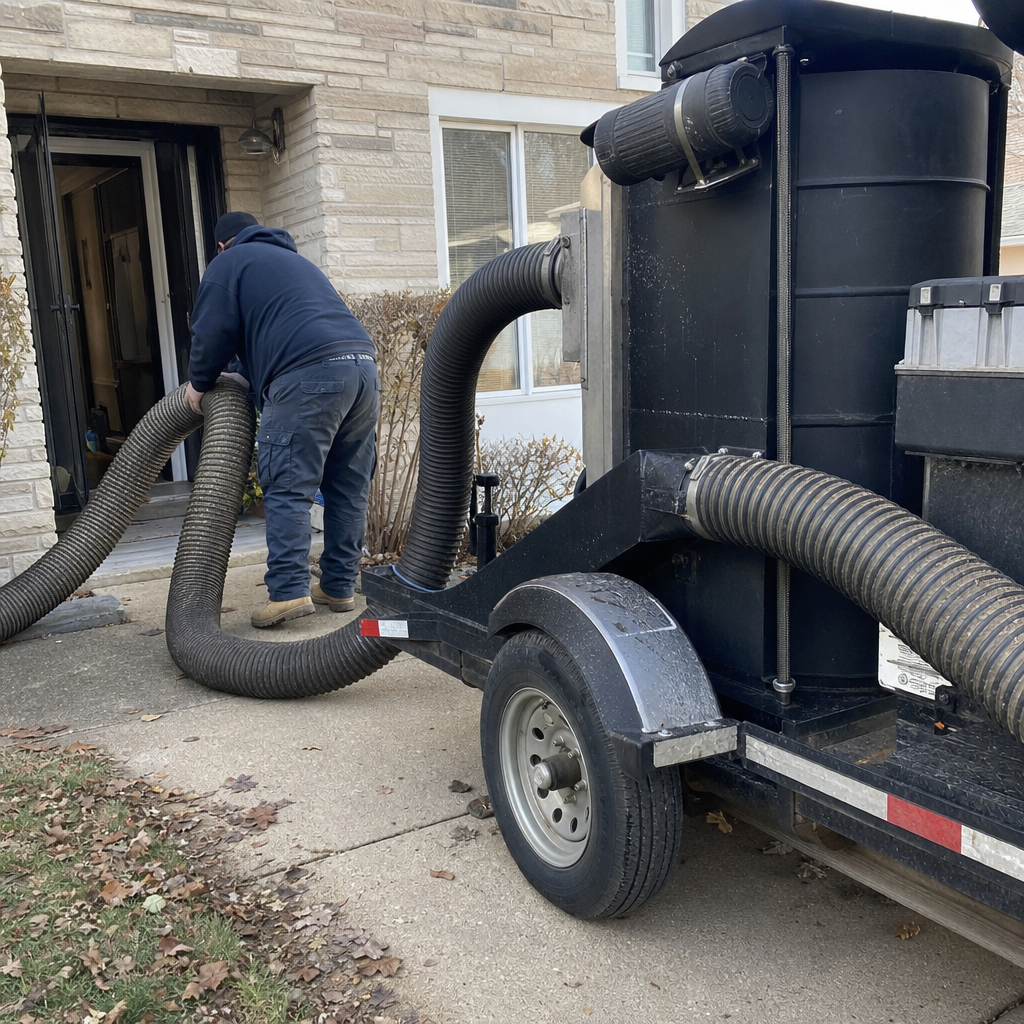
How Often Should Chicago Homeowners Clean Their Air Ducts? (It’s Probably Sooner Than You Think)
Most air ducts in Chicago homes should be professionally cleaned every 2 to 4 years — not the 3-to-5-year interval you’ll read on most national HVAC sites — but many homeowners first ask Is Air Duct Cleaning Worth It? (Chicago, IL) before scheduling. That wider guidance was written with newer construction in mild climates in mind. Chicago’s near-year-round HVAC cycle, pre-war housing stock, and lakefront humidity compress that timeline in ways those generic recommendations never account for. If your home has never had a professional cleaning, the interval question doesn’t apply yet — first you need a baseline. Call (833) 223-3823 for a no-obligation assessment.
Why the 3-to-5-Year Rule Doesn’t Hold Up in Chicago
The standard interval assumes three things: that the duct system was installed when the house was built, that it runs through conditioned space, and that the HVAC doesn’t run hard year-round. Most Chicago homes meet none of those conditions — and in neighborhoods like Portage Park, Bridgeport, or Beverly, missing all three at once is the norm rather than the exception.
Chicago has roughly 80,000 brick bungalows built between 1910 and 1940, originally heated by steam radiators. When forced air arrived — typically in the 1960s or 70s — duct runs were retrofitted into crawlspaces, tight basements, and repurposed closets that were never designed for them. The result is often undersized, poorly sealed ductwork that accumulates debris faster than a purpose-built system and is harder to access and inspect. Many of those systems haven’t seen a cleaning brush since installation.
Add to that a climate that pushes furnaces hard through sub-zero polar vortex winters and then pivots to air conditioning through humid 90°F summers. Your HVAC equipment in Chicago runs close to year-round. More runtime means more air movement, more particle capture, and faster buildup inside the duct walls — full stop.
Finally, older duct materials shed particulate more readily than modern systems. Galvanized sheet metal from the 60s develops surface oxidation. Flex duct from the 80s and 90s develops micro-tears in the liner. Both release debris back into your air supply over time, which is a problem no amount of filter changes fully addresses. Ronald Cooper, Owner and Lead Technician at Anchor Air Duct Cleaning Service Greater Chicago, has pulled debris profiles from Chicago bungalow ductwork that reflect 40 or 50 years of layered accumulation — and after 11 years of doing this work across the city, he can read what decade a system was installed just from what comes out of it.
Chicago Housing Type Changes Everything: A Practical Comparison
Treating a Wicker Park three-flat the same as a new Lincoln Park condo when it comes to duct cleaning intervals is how the generic rule fails homeowners. Here’s a more honest breakdown by housing type:
- Chicago bungalow, original retrofitted ductwork, pets present: Clean every 2 years. The combination of older duct material, crawlspace debris infiltration, and pet dander loading shortens the effective service interval more than any single factor alone.
- Pre-war two-flat or three-flat, separate unit duct systems: Clean every 2 to 3 years per unit. Short, poorly accessible duct runs in these buildings accumulate debris disproportionately fast relative to their total length, and unit turnover introduces new particle loads between occupancies.
- Postwar brick ranch or raised ranch, original or updated ductwork: Clean every 3 years, adjusted shorter if there’s evidence of pest activity or recent renovation work.
- Newer condo or townhome, purpose-built duct system, no pets: The 3-to-5-year window is reasonable here — but even these systems benefit from an inspection after major renovations, which release fine construction dust directly into open registers.
- Any home after a first-time professional clean: Use the actual condition found at the first visit as your baseline. If the initial clean was significant, schedule a follow-up inspection at 18 months to re-evaluate the rate of accumulation before locking in an interval.
One note specific to bungalow-belt neighborhoods: technicians in Chicago — including our crews — periodically discover original 1960s sheet-metal supply lines wrapped in cloth-backed insulation that tests positive for asbestos. That material was common during the radiator-to-forced-air conversion era. When we encounter it, work stops immediately and we refer the homeowner to a licensed abatement contractor before any cleaning proceeds. It’s not a common finding, but in Bridgeport, Beverly, and similar neighborhoods, it’s not rare either — and it’s exactly the kind of thing a first-time cleaning surfaces.
The Lakefront Variable: Edgewater, Rogers Park, and South Shore
Residents in Chicago’s lakefront neighborhoods face an additional factor that most cleaning interval guides never mention: persistently elevated ambient humidity from Lake Michigan’s shoreline effect. In below-grade units of older greystone buildings in Edgewater, Rogers Park, and South Shore, that humidity doesn’t stay outside — it migrates into the ductwork, especially in systems with any gaps or poor sealing at the joint connections.
Moisture inside ductwork creates conditions favorable to microbial growth. You won’t necessarily see visible mold at the registers — the colonization typically begins further inside the system, on debris accumulations that hold moisture against the duct wall. This is why a shorter inspection interval is appropriate for lakefront basement and garden units regardless of how clean the registers look from the outside.
For these situations, a cleaning paired with a professional sanitizing treatment using Abatement Technologies or Guardsman products addresses both the physical debris and the microbial load in a single visit. That combination matters — cleaning alone removes the substrate, but sanitizing addresses residual contamination that cleaning brushes don’t reach.
Observable Triggers: When the Calendar Isn’t the Right Guide
Calendar-based intervals are a starting point, not a substitute for paying attention to what your home is telling you. Clean ducts aren’t glamorous — but neither is replacing a blower motor because nobody checked what was clogging the airflow for a decade. Several conditions call for a professional cleaning regardless of when the last one happened:
- Reduced airflow from registers: If rooms that used to heat or cool evenly now lag noticeably, debris restriction is one of the first things to rule out.
- Visible debris or dust accumulation at register faces: A light film is normal. A visible dark ring or debris buildup inside the register throat is not — it signals active shedding from inside the duct run.
- Allergy or respiratory symptom onset tied to HVAC use: Symptoms that worsen when the system runs and improve when it doesn’t are a direct indicator of duct-borne particle loading.
- Recent renovation or remodeling: Drywall dust, joint compound, and insulation fibers from even a modest kitchen or bathroom remodel enter open registers and coat duct interiors. Schedule a cleaning within six months of any significant interior work.
- Confirmed or suspected pest activity: Rodent droppings, nesting material, or insect debris inside ductwork contaminate air supply and won’t be resolved by air filter replacement. This is a hard trigger for an immediate cleaning.
- Moving into a home with unknown duct history: If you don’t know when the ducts were last cleaned — or if they ever were — you don’t have an interval. You have an unknown starting condition. A first-time professional clean resets that baseline and gives you something real to work from.
For Chicago homeowners specifically, we’d add one more: the first fall startup after a summer where the AC ran heavily. High-humidity summers followed by the moisture-dense shoulder season create the window where any accumulated debris is most biologically active.
What a First-Time Clean Actually Reveals in Chicago Homes
After 11 years of cleaning ductwork across Chicago — from Edgewater to Beverly, from Logan Square two-flats to Hyde Park courtyard buildings — Ronald Cooper has developed a clear picture of what first-time cleans typically uncover, organized by decade of duct installation:
- Systems installed in the 1960s–70s: Consistent findings of layered fine debris and oxidation from the galvanized metal itself, occasional fiberglass liner fragmentation, and in a meaningful percentage of Southside bungalow jobs, the cloth-backed insulation flag mentioned above.
- Systems from the 1980s–90s: Flex duct liner degradation, higher pet dander and carpet fiber content, and frequent debris accumulation at the transition points where flex connects to rigid metal — those joints seal poorly and collect material at the seam.
- Systems from the 2000s onward: Generally cleaner, but renovation debris and filtration failures (running a system with a loaded or collapsed filter) leave localized heavy deposits near the air handler that propagate through the entire system.
This isn’t anecdotal pattern-matching — it’s what drives the interval recommendations above. The condition found at a first-time clean is the single most reliable predictor of how quickly that system will need attention again.
Our professional-grade Rotobrush and Nikro extraction systems give us access to the full duct run during that first clean — not just the registers you can see. That distinction matters when you’re trying to assess actual system condition rather than just surface appearance. You can learn more about what that process looks like on our Air Duct Cleaning in Chicago service page.
If you’re weighing whether it’s time, our Air Duct Cleaning service page covers what’s included in a full professional clean from start to finish.
Frequently Asked Questions About Air Duct Cleaning Intervals in Chicago
Older Chicago homes — particularly pre-war bungalows, two-flats, and greystones with retrofitted duct systems — should have their air ducts cleaned every 2 to 3 years, not the 3-to-5-year interval commonly cited for newer construction. The combination of older duct materials, crawlspace-routed runs, and Chicago’s year-round HVAC cycle accelerates debris buildup faster than those general guidelines account for. If the system has never been professionally cleaned, start with a baseline assessment before establishing any interval — call (833) 223-3823 for a free estimate and to discuss Whole House Air Duct Cleaning Cost in Chicago, IL.
Yes — several observable signs indicate cleaning is overdue before you call anyone: visible debris or a dark accumulation ring inside the register throat (beyond a thin dust film), uneven room heating or cooling that wasn’t present before, allergy symptoms that correlate with HVAC operation, or any recent interior renovation. These are harder triggers than a calendar date and more reliable for Chicago homes, where housing age and duct condition vary so widely by neighborhood and decade of installation.
For residents in lakefront Chicago neighborhoods like Edgewater, Rogers Park, and South Shore — particularly those in below-grade or garden units of older greystone buildings — yes, proximity to the lake meaningfully affects the recommended inspection interval. Lake Michigan’s shoreline effect produces persistently elevated ambient humidity that can migrate into ductwork, accelerating microbial growth on debris accumulations inside the system. A shorter inspection interval and a sanitizing treatment combined with cleaning are both appropriate responses for these situations.
A first-time professional air duct cleaning functions as a baseline reset — it establishes the actual condition of your system so that future service intervals can be calibrated to real-world findings rather than a generic calendar. At Anchor Air Duct Cleaning Service Greater Chicago, Ronald Cooper personally runs the Rotobrush and Nikro extraction equipment on every job, inspecting the full duct run rather than just the visible register faces. What we find in a Chicago home that’s never been cleaned is often a direct reflection of the decade the system was installed — and that finding shapes every future service recommendation we make for that home.
Ready to Know What’s Actually in Your Ducts?
If you’re not sure when your Chicago home’s ducts were last cleaned — or if the answer is never — Anchor Air Duct Cleaning Service Greater Chicago offers Affordable Air Duct Cleaning in Chicago, IL with a straightforward, no-pressure assessment to give you a real starting point. Ronald Cooper leads every job personally, and estimates are always free. Call (833) 223-3823 to schedule yours.
Written by Ronald Cooper, Owner & Lead Technician at Anchor Air Duct Cleaning Service Greater Chicago, serving Chicago, IL.